
Free Transition Worksheets for High School and 18–22 Programs
These free transition worksheets are for high school transition classes and young-adult transition programs, often called 18–22 programs. They cover goal setting and self-advocacy, exploring careers, applying and interviewing for jobs, getting along at work, and everyday tasks such as making phone calls. There's no sign-up and no email form. Preview a sheet, then download the PDF.
They're written for special education teachers, transition coordinators, vocational rehabilitation (VR) counselors, Pre-ETS providers, and families helping a student plan for life after high school. Print one copy per student. Most sheets are a single page, and they work with a whole class, a small group or one student at a time. Sort them by skill area or Pre-ETS service with the filters below. Finished sheets can go in a student's transition portfolio.
Filter the worksheets
Showing all 30 worksheets
Self-Determination: goals, self-advocacy and planning
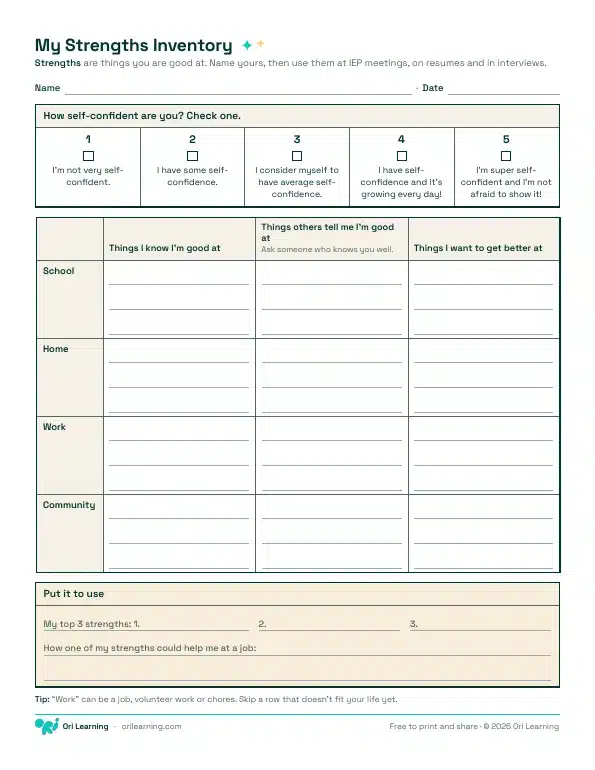
Strengths Inventory
Students rate their self-confidence, list strengths and things to work on at school, home, work and in the community, then pick their top three.
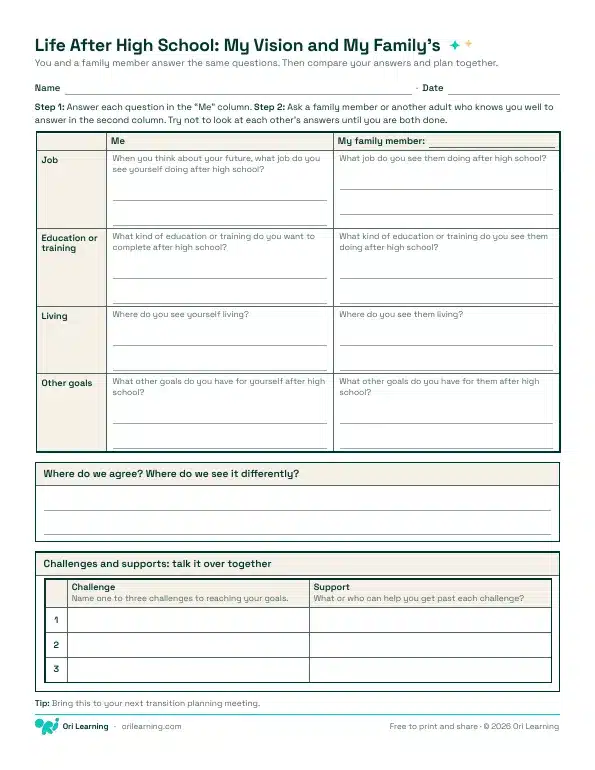
Life After High School: My Vision and My Family's
A student and a family member separately answer questions about work, training and living after high school, then compare and list challenges and supports.
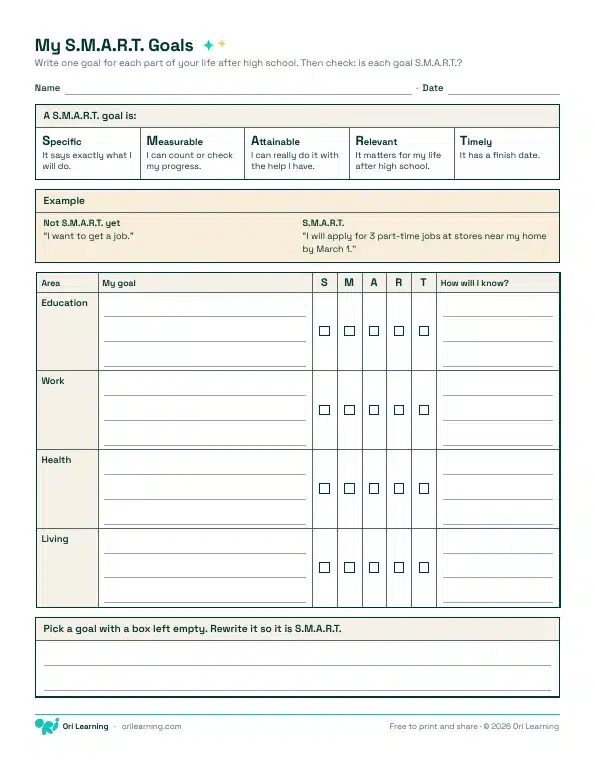
SMART Goals Worksheet for Students
Students write goals for education, work, health and living, check each one against SMART, then rewrite one that falls short.
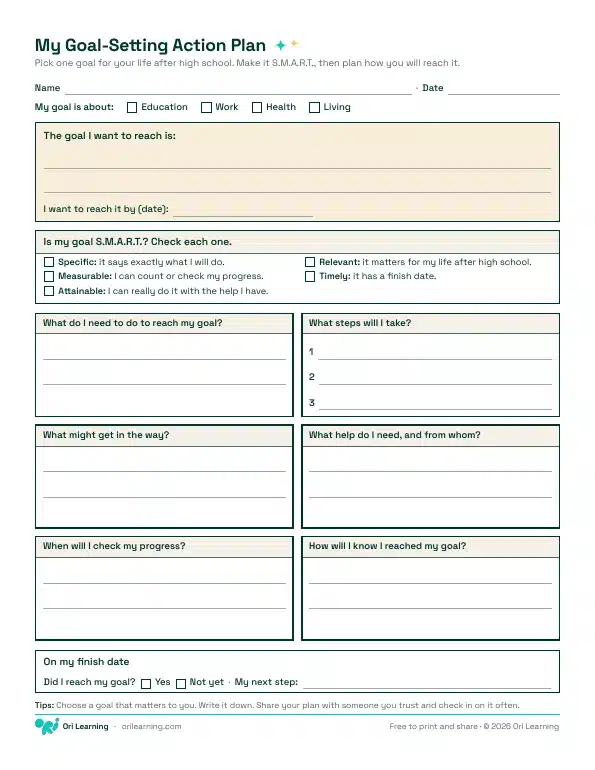
Goal-Setting Action Plan
This goal setting worksheet takes students from one goal for life after high school to a SMART check, three steps and a finish date.
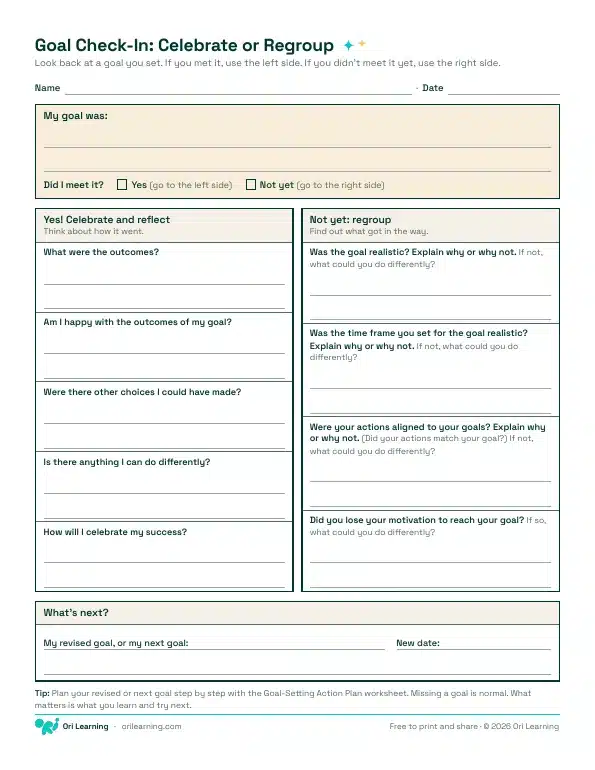
Goal Check-In: Celebrate or Regroup
A follow-up to the Goal-Setting Action Plan. Students reflect on a goal they met, or work out why one stalled and set a revised goal.
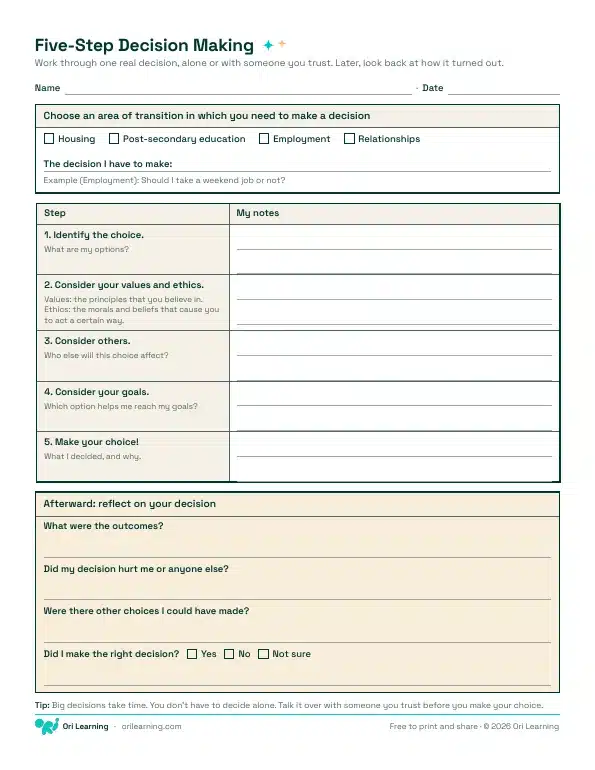
Five-Step Decision Making
Students take one real decision about housing, education, work or relationships through five steps, then look back at how it turned out.
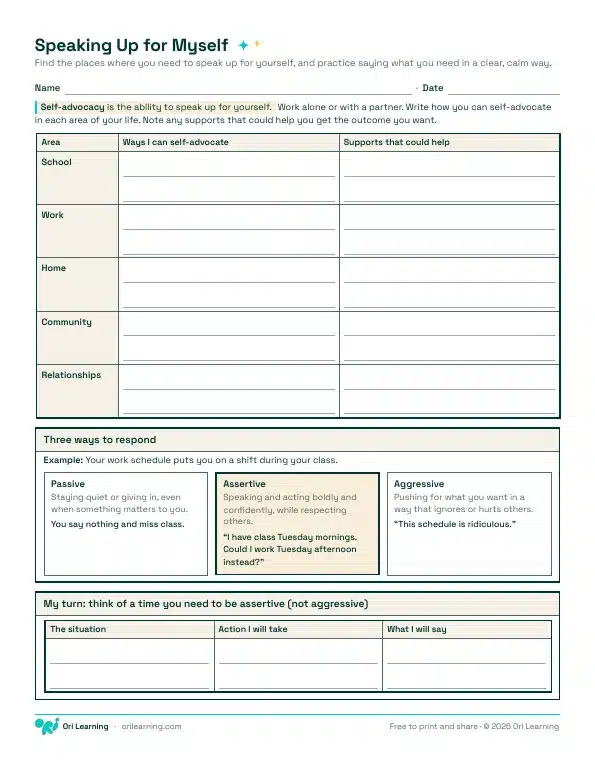
Speaking Up for Myself
A self-advocacy worksheet. Students note where they need to speak up for themselves, compare passive, assertive and aggressive replies, and plan what they'll say.
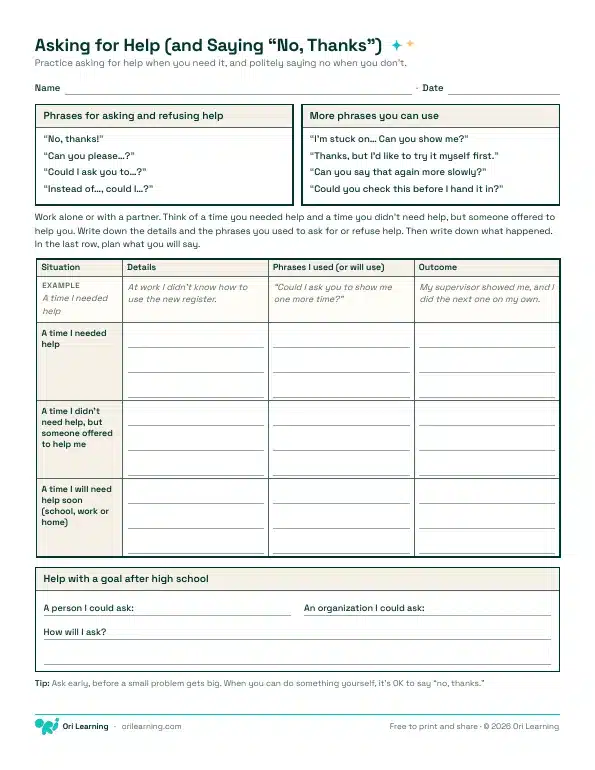
Asking for Help (and Saying "No, Thanks")
Students use a phrase bank to ask for help or politely say no, write about real times for each, and plan one future ask.
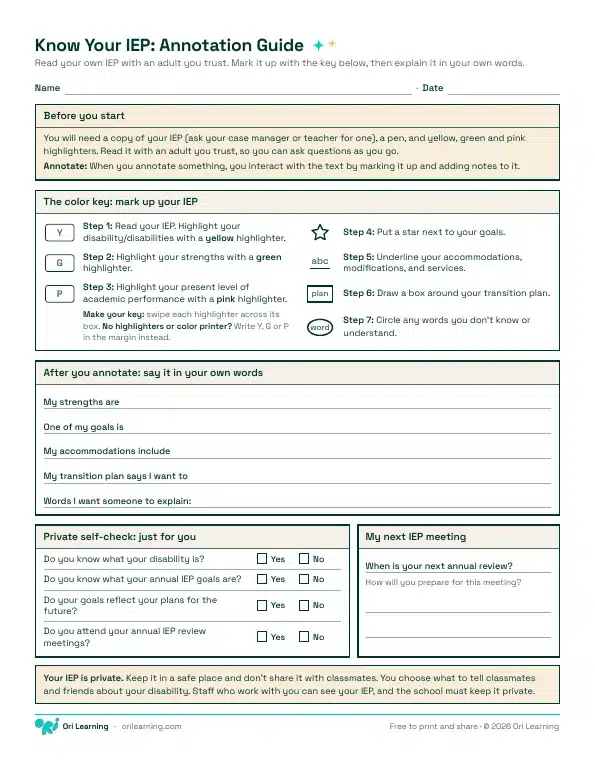
Know Your IEP: Annotation Guide
With a trusted adult, students mark up their own IEP using a color key, then explain their goals and transition plan in their own words.
 2 pages
Accommodations: Now and After High School
Students rate each support they get now (keep, change or drop), then get ready to ask for accommodations themselves in college or at work.
 2 pages
Transition Support Network
Students list the people they can count on, their school's resources, and adult agencies such as VR and Centers for Independent Living, then visit one.
 2 pages
Transition Meeting Prep
Students note their supporters, strengths, needs, plans and the accommodations that work, then use the sheet to lead their IEP transition meeting.
Employment Skills: exploring careers, getting hired and keeping a job
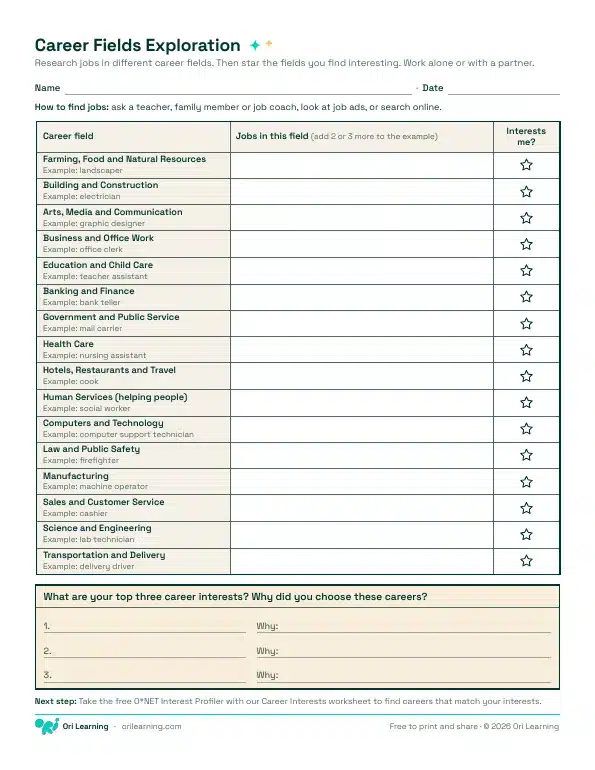
Career Fields Exploration
Students list jobs in 16 career fields, from health care to manufacturing, star the fields that interest them, then explain their top three choices.
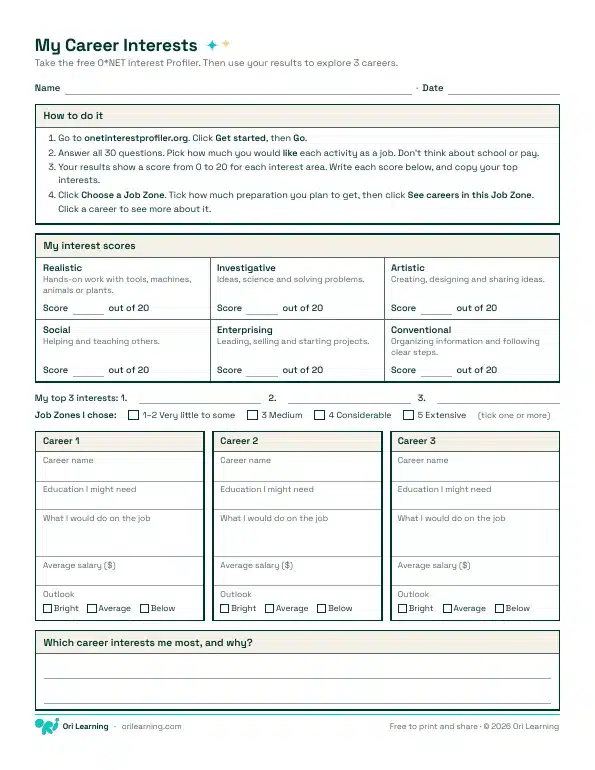
Career Interests Worksheet (with the O*NET Interest Profiler)
A career exploration worksheet that uses the free O*NET Interest Profiler. Students log their six interest-area scores and research three careers online.
 2 pages
Informational Interview Planner
Students plan a short talk with someone in a job they're curious about, pick five questions, take notes, then draft a thank-you note.
 2 pages
Job Shadowing and Work Experience Log
Students choose questions to ask before a job shadow, internship or volunteer shift, and afterward finish sentence frames about what they did and learned.
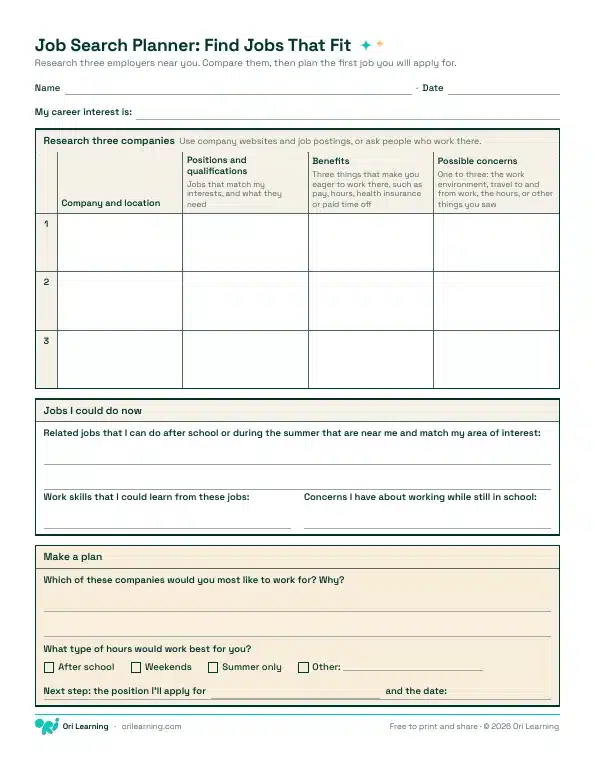
Job Search Planner: Find Jobs That Fit
Students compare three local employers on openings, qualifications, benefits and concerns, then choose the hours that suit them and the first job they'll apply for.
 3 pages
Resume and Cover Letter Worksheet
This resume worksheet has a sample high school resume, a builder to fill in, and a sample cover letter with a planner.
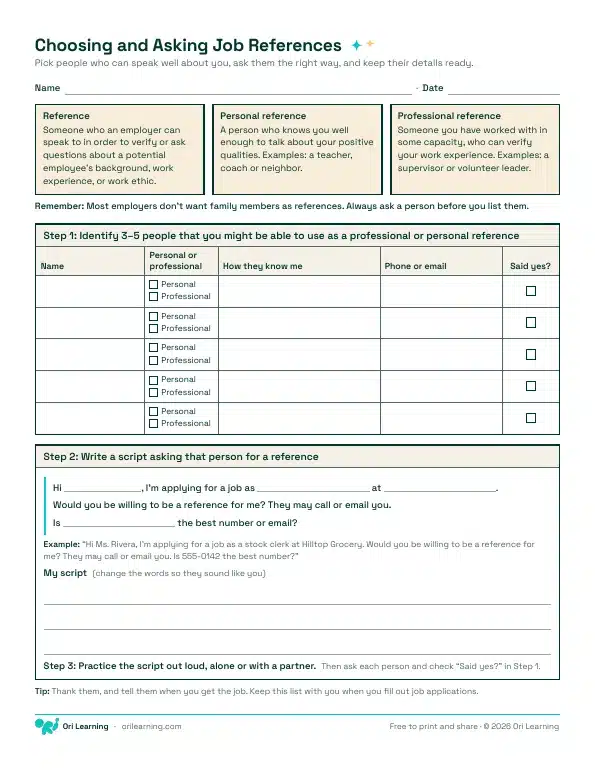
Choosing and Asking Job References
Students list three to five possible references, write and practice a script for asking each one, and keep the contact details ready for job applications.
 2 pages
Practice Job Application for Students
A full practice job application for students. They gather their details first, fill it out once, then keep it to copy from.
 2 pages
Job Interview Prep
Students research one real job opening, plan questions for the employer, write two interview answers from models, then practice them aloud and rate themselves.
Next step: have students practice for interviews with our 42 mock interview questions for high school students.
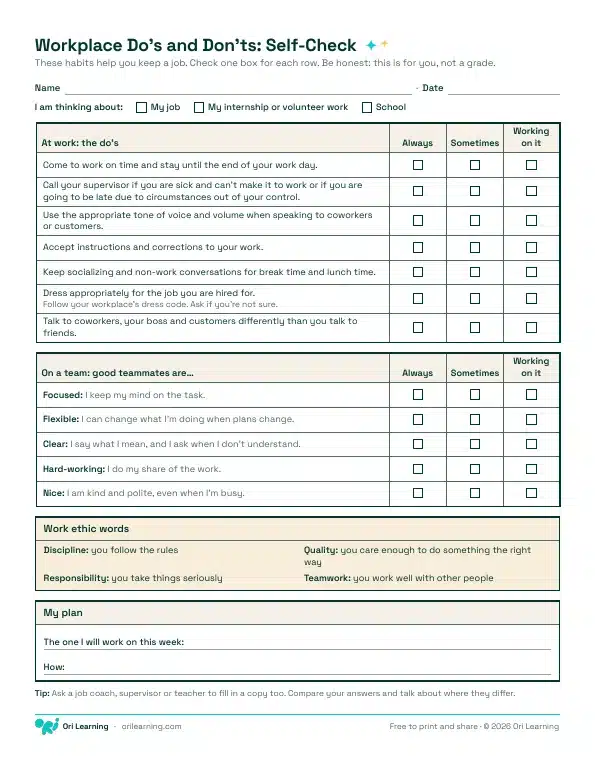
Workplace Do's and Don'ts: Self-Check
Students rate themselves on habits that keep a job, such as being on time, calling in and taking correction, then pick one to work on.
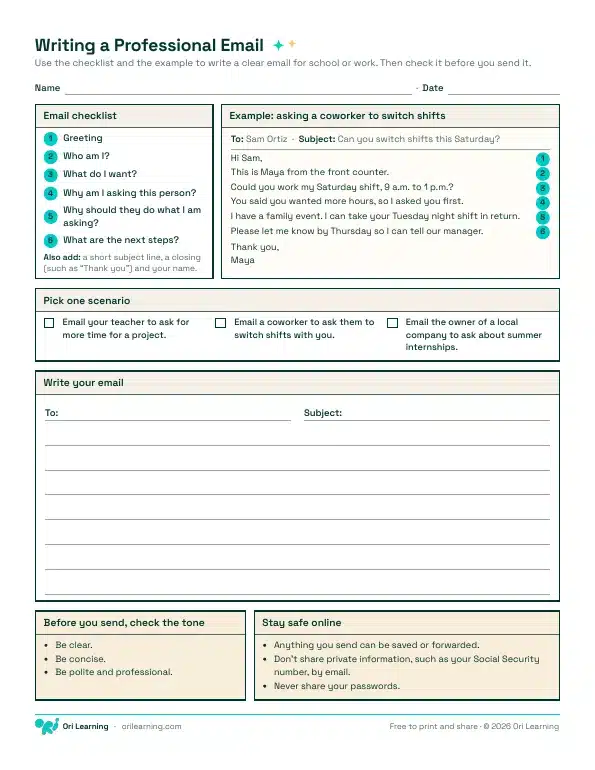
Writing a Professional Email
Students follow a six-point checklist and an annotated example to write an email to a teacher, coworker or local business, then check its tone.
Social Skills: communication and working through conflict
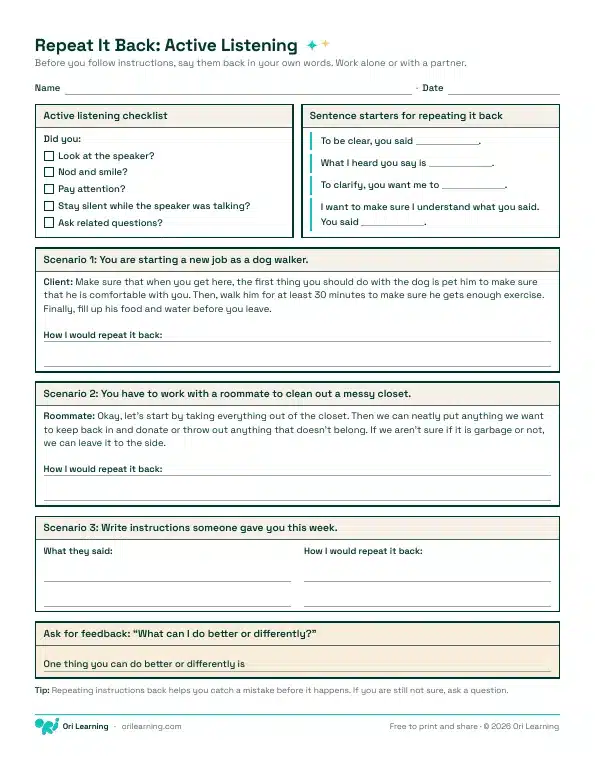
Repeat It Back: Active Listening
Students practice repeating instructions back in their own words, using sentence starters, an active listening checklist and three short scenarios.
 2 pages
Starting and Ending Conversations
Students use formulas such as "compliment + question" to start and end small talk, read model scripts, then write their own for four scenarios.
 2 pages
Feedback at Work
Students practice giving feedback and thanking a coworker, then taking correction from a supervisor and owning a mistake in four steps.
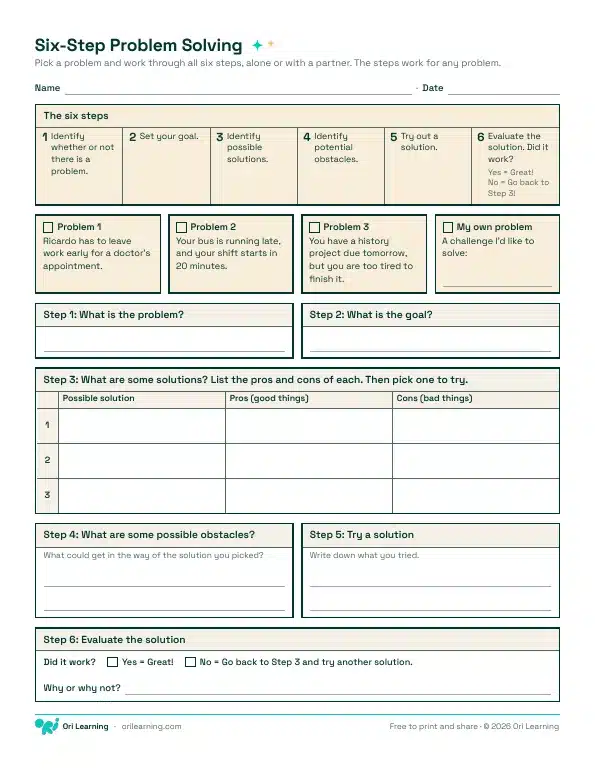
Six-Step Problem Solving
Students take one problem, like a late bus before a shift, through six steps, from setting a goal to trying a solution and checking it worked.
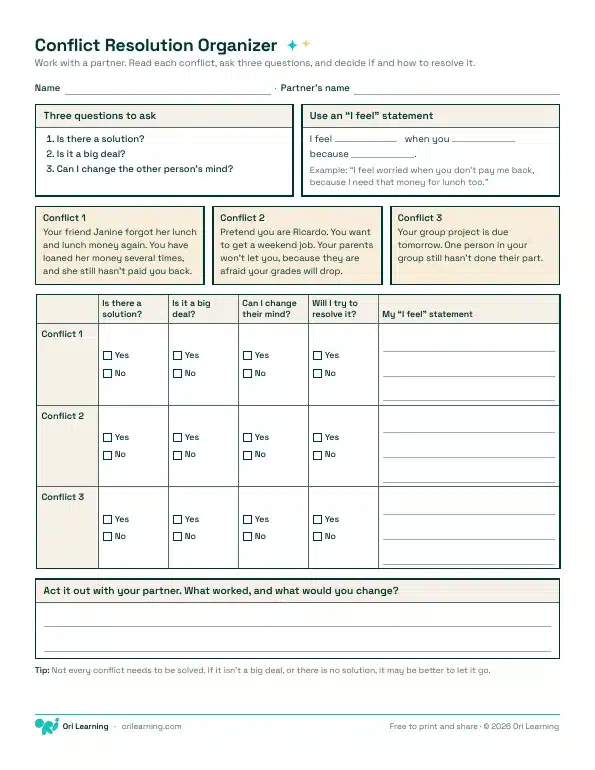
Conflict Resolution Worksheet for Teens
Partners use three questions and an "I feel… when you… because…" statement to work through three everyday conflicts with a friend, parents and a classmate, then act them out.
Independent Living: everyday communication
 2 pages
Phone Call Skills for Work and Life
Students use three checklists to script calling in late, answering the phone, and leaving and taking messages, then plan and make one real call.
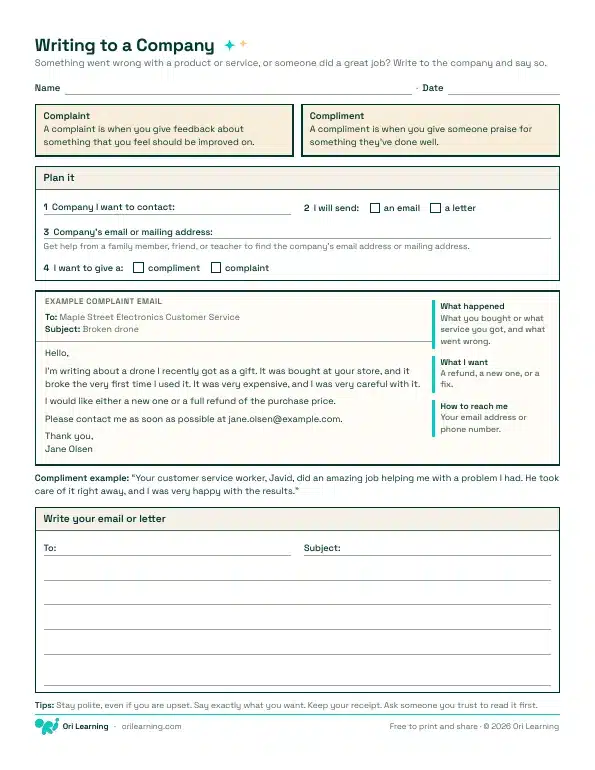
Writing to a Company
Students plan and write an email or letter to a company: a complaint asking for a refund or fix, or a compliment for good service.
Using these worksheets in transition planning
The goal sheets cover education and training, employment, independent living and health. The first three match the postsecondary goals in a transition plan, where independent living goals are written when appropriate. What a student writes on them can feed the conversation about the measurable postsecondary goals in their IEP. The sheet is the student's own planning tool; it doesn't replace the goals written in the IEP. For the annual goals in the IEP, see how to write SMART IEP goals, one common way to make goals measurable. That's a separate job from the SMART sheet, which students fill out themselves, with support as needed.
The sheets can support classroom work for four of the five required Pre-ETS services. As a suggested fit, the Career Fields, Career Interests, Informational Interview and Job Search sheets support job exploration counseling. The Job Shadowing and Work Experience Log helps students prepare for and reflect on work-based learning experiences (such as job shadowing, workplace tours or internships, provided in an integrated community setting to the maximum extent possible); it doesn't take the place of the experience. The other Employment Skills sheets, and the Social Skills and Independent Living sheets, support workplace readiness training. The Self-Determination sheets, except the Life After High School family sheet, support instruction in self-advocacy, including getting ready to request accommodations after high school. None of the sheets is built for counseling on enrollment in college and other postsecondary programs. The sheets are teaching materials, not Pre-ETS on their own. The state vocational rehabilitation (VR) agency works with schools to provide or arrange Pre-ETS, and it is responsible for classifying and documenting those services under federal rules and state VR policy. Our guide to Pre-ETS for schools covers the five services and who is eligible.
Students build these skills a little at a time, in high school and after. Read about transition skills for high school students. For ways to run the sheets as class activities, see transition activities for high school students.
Teaching a full transition course?
The sheets on this page cover a few pieces of transition instruction. Ori Learning's Transition Curriculum is a full curriculum, with courses for high school students in Grades 9–12 and for 18+ programs. Its units cover self-determination, education and training, employment skills, independent living, social skills, and health and wellness, with over 180 lessons in all. Lessons come with a teacher guide and printable worksheets, and they include tiered activities. If you teach transition every day and want a planned sequence instead of single sheets, see how the curriculum is put together.
Free to print and share
You're welcome to print, copy and share these sheets with students, families and colleagues, and to post them in your class LMS or Google Classroom. Please don't sell them. If you'd like to share them on a public website, link to this page instead of re-uploading the files, so people always get the current version.