
Adult Transition Curriculum (Ages 18+)
A functional curriculum designed for adult transition programs—helping learners apply skills for work, independent living, and community participation.

6 Units · Ages 18–22+ · 3 Leveled Entry Points · Pre/Post Assessments
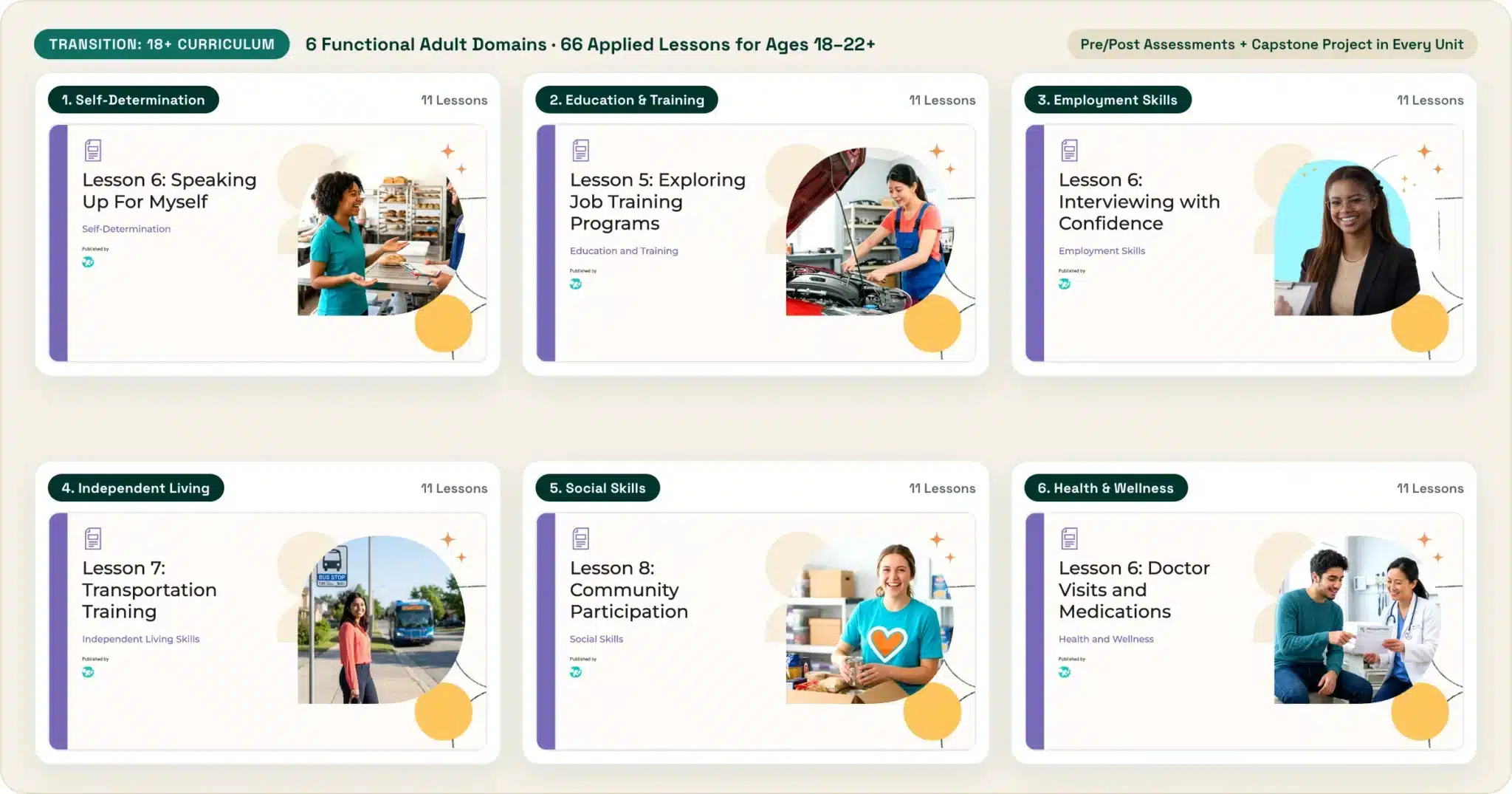
Adult Transition Curriculum Across 6 Core Domains
Six units (11 lessons each) focused on the skills adults use every day—in real settings.
See the Adult Transition Curriculum in Action
Video transcript
Ori Learning’s Adult Transition Curriculum helps 18-to-22 programs teach young adults with mild-to-moderate disabilities the skills for work, job training and independent living in the community. Part of one pathway from ninth grade through adulthood.
Six units, organized by skill, so you teach what each learner needs next. Programs that serve students receiving Pre-ETS will find lessons on job exploration, workplace readiness and self-advocacy.
Learners practice taking part in their own IEP meetings: naming their strengths, the supports that help them, and their goals. For teachers, each unit links its lessons to sample IEP goals and objectives.
Lessons are built around Universal Design for Learning and follow the 5E instructional model. In a lesson on shopping with a budget, each learner works at one of three levels and sees only their own: matching words to pictures, solving shopping scenarios, or planning a real twenty-dollar trip.
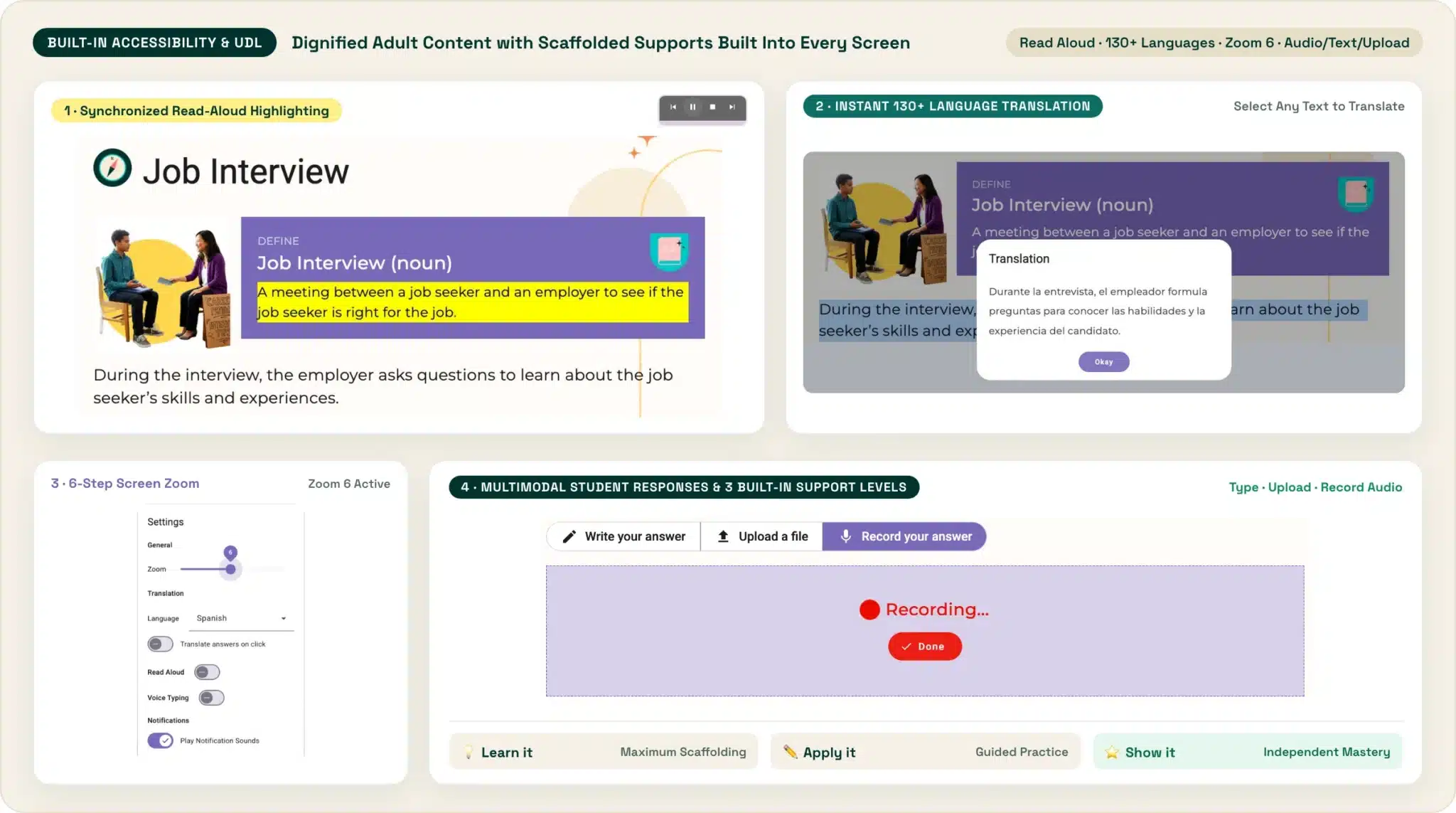
Activities let learners sort, choose, write and record their answers. Text can be read aloud, answers can be spoken, and any selected text translates into more than 130 languages.
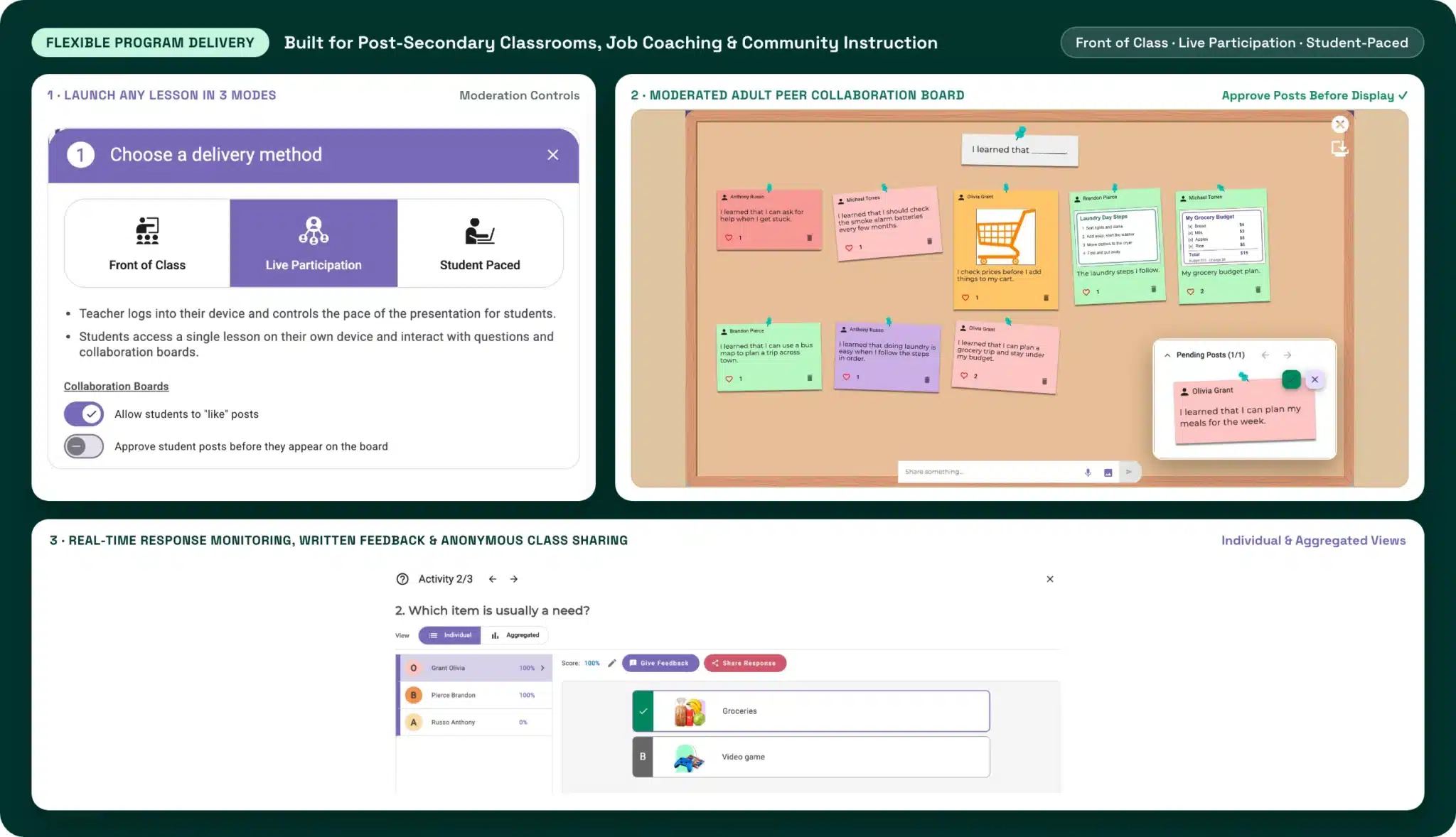
Present to the whole group, let learners work at their own pace, or run a live lesson. In a live lesson, everyone moves through the lesson together, with you setting the pace. As learners answer, every response and score comes straight to you.
On collaboration boards, learners post their ideas in words and images and like each other’s posts, and you can approve posts before the group sees them. Every lesson comes with a teacher guide, and every lesson and worksheet can also be delivered on paper.
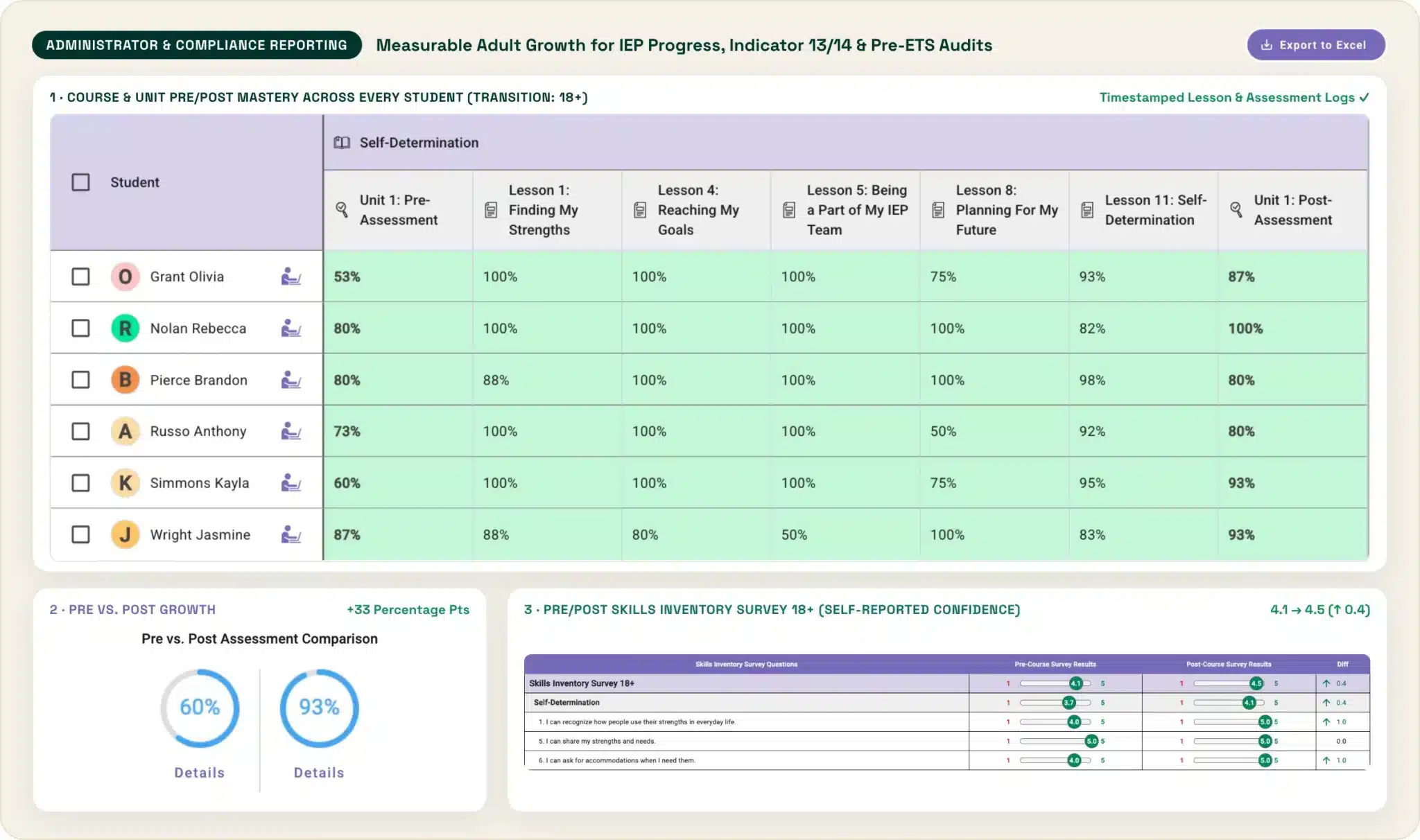
Pre-assessments, post-assessments and the Skills Inventory Survey let you measure growth, and the Progress view shows every learner, lesson by lesson. Your team can draw on all of it for transition planning and Indicator 13.
Book a demo at orilearning.com.
What's Included in the Adult Transition Curriculum
| Unit | Lessons | Skills Students Practice |
|---|---|---|
| Self-Determination (11 lessons) |
Finding My Strengths, Where I Need Support, Improving My Skills, Reaching My Goals, Being a Part of My IEP Team, Speaking Up for Myself, Understanding My Rights, Planning for My Future, Self-Reflection and Growth, Celebrating My Independence, End of Unit Projects | Self-awareness, self-advocacy, rights, IEP participation, future planning |
| Education & Training (11 lessons) |
Why School Matters, Getting Organized, Following Directions, Learning Supports, Exploring Job Training Programs, Using Technology to Learn, Everyday Academic Skills, Problem Solving When I’m Stuck, Learning in the Community, Time Management for Life, End of Unit Projects | Organization, technology, community learning, time management |
| Employment Skills (11 lessons) |
My Interests, My Future Job; Understanding What a Job Is; How to Find a Job; Building a Resume; Filling Out Job Applications; Interviewing with Confidence; Workplace Etiquette; Workplace Communication; Work Ethic; Workplace Safety; End of Unit Projects | Job readiness, applications, interviews, workplace behavior |
| Independent Living (11 lessons) |
Getting Dressed, Doing Laundry, Household Management, Shopping with a Budget, Cooking and Meal Prep, Apartment Basics, Transportation Training, Going to a Restaurant, Emergency Preparedness, Planning My Day, End of Unit Projects | Daily routines, household management, budgeting, transportation, safety |
| Social Skills (11 lessons) |
Making a Good First Impression, Personal Space and Boundaries, Starting Conversations, Handling Conflicts, Going Out With Friends, Being a Good Friend, Online Etiquette and Safety, Community Participation, Giving and Receiving Feedback, Leadership and Teamwork, End of Unit Projects | Communication, relationships, conflict resolution, community engagement |
| Health & Wellness (11 lessons) |
Personal Hygiene and Self-Care, Healthy Eating Habits, Exercise and Movement, Sleep and Routines, Managing Stress, Doctor Visits and Medications, Safety and First Aid, Mental Health Awareness, Healthy Relationships, Building a Wellness Plan, End of Unit Projects | Hygiene, nutrition, exercise, stress management, mental health, safety |
Courses and units include pre/post assessments (paired with student skills inventories), and core skill lessons feature 3 leveled entry points (Learn it, Apply it, and Show it) with age-appropriate activities. The curriculum emphasizes self-directed learning with journal reflection and scenario-based practice connecting skills to real-world settings.
Supporting Students Who Receive Pre-ETS
Pre-Employment Transition Services (Pre-ETS) are provided or arranged by your state vocational rehabilitation (VR) agency, in collaboration with schools. Ori Learning’s adult transition curriculum teaches the classroom skills behind three of the five required activities (job exploration, workplace readiness and self-advocacy) and prepares students for work-based learning.
| Pre-ETS Activity | Related Ori Learning Lessons |
|---|---|
| Job exploration counseling | My Interests, My Future Job; Understanding What a Job Is; How to Find a Job |
| Workplace readiness training | Workplace Etiquette; Workplace Communication; Work Ethic; Workplace Safety |
| Instruction in self-advocacy | Being a Part of My IEP Team; Speaking Up For Myself; Understanding My Rights; Where I Need Support |
| Work-based learning experiences | Preparation only: Building a Resume; Filling Out Job Applications; Interviewing with Confidence. The experience itself takes place in a workplace or the community. |
| Counseling on postsecondary options | Introduced in Exploring Job Training Programs and Learning in the Community |
Get the 18+ Transition Scope & Sequence
Review the full unit progression, lesson objectives, and standards alignment for the adult transition curriculum.
Inclusive Instruction for Diverse Learners
Universal Design for Learning
Adult transition programs often serve a mix of learning profiles in a single room. We’ve built supports into the platform to engage students with mild-to-moderate support needs alongside those ready for independent work.
- Leveled Entry Points: Learn it, Apply it, and Show it pathways in core skill lessons meet learners where they are.
- Voice & Choice: Learners demonstrate understanding through sorting, matching, writing, file uploads, or audio recording.
- Built-In Accommodations: Integrated read-aloud highlighting, speech-to-text, zoom, and translation of selected text in 130+ languages.
Flexible Delivery for Dynamic Programs
FOR TEACHERS
Adult transition schedules are rarely static. Whether you have a full group for morning meeting or students rotating in and out from job sites, our platform adapts to the flow of your day.
- 3 Delivery Modes: Instantly switch between Front-of-Class (group instruction), Student-Paced (independent work), or Live Participation (interactive).
- Collaboration Boards: Digital sticky notes for class discussion with moderation controls.
- Zero-Prep Planning: Comprehensive guides include pacing, functional vocabulary, and objectives so you can focus on students, not setup.
Progress Records Your Team Can Use
FOR ADMINISTRATORS
Lesson completion, pre/post assessment scores and timestamped student responses give your team records to draw on for IEP progress and district reporting.
- Progress Reports: Detailed course progress reports with lesson and pre/post assessment scores export to Excel.
- Lesson Completion Records: See which lessons each learner has completed, so you know what was taught, not just planned.
- Timestamped Student Responses: Student work is timestamped, giving you records to draw on when documenting progress toward postsecondary goals.
-
Consistent Framework: Built on the same 6 core domains as our high school curriculum, so skills carry forward from grades 9–12 into adult programs.
Learn more about our high school transition curriculum
Frequently Asked Questions About Adult Transition Curriculum
How is adult transition curriculum different from high school transition curriculum?
While both curricula share the same six-domain framework, adult transition curriculum emphasizes applied independence and self-direction. Adult lessons focus on IEP participation, community-based skills, and workplace readiness rather than foundational exploration. Learn about the high school transition curriculum.
How do you teach self-advocacy and IEP participation to adult learners with disabilities?
Ori Learning includes dedicated lessons on self-advocacy and IEP participation: “Being a Part of My IEP Team,” “Speaking Up For Myself,” and “Understanding My Rights.” These lessons use scenario-based practice and journal reflection to help learners prepare for real IEP meetings, understand their legal rights, and communicate their needs and goals effectively.
Can this curriculum be used in community-based instruction settings?
Yes. The flexible delivery model allows lessons to be used in classroom settings, community-based instruction (CBI), job coaching contexts, and small-group or independent work. Lessons on transportation, workplace communication, and community resources are designed to transfer directly to real-world environments.
How can adult transition programs document progress toward IEP transition goals?
Course and unit pre/post assessments, paired with student skills inventories, measure skill growth over time. Assessment data can be used to document progress toward measurable postsecondary goals in the student’s IEP, support transition planning conversations, and demonstrate program effectiveness to administrators and funding agencies.
Curriculum designed by Tynishia Williams, M.Ed., Tess Hileman, M.Ed. and Dr. Miriam Gayle, EdD — bringing decades of experience in special education, transition planning, and curriculum development to every lesson.
A Continuation of the Secondary Journey
Our Adult track is the final stage of a vertically aligned pathway. See how our High School Transition Curriculum builds the foundation, or get the full Scope & Sequence to review the complete framework.