
High School SEL Curriculum for Grades 9–12
Part of Ori Learning’s Emotional Well-Being Curriculum for grades 6–12
Four courses, one each for grades 9, 10, 11 and 12, help students manage stress, build healthy relationships, recognize bias, set goals and make the big decisions that come with finishing high school. Each grade has 25 lessons aligned to CASEL’s five competencies.
Courses
4 (grades 9, 10, 11 and 12)
Units
20
Lessons
100
Lesson length
20-minute core lessons + extensions
Assessment
Pre/post for every course and unit
What High Schoolers Work On
High school brings more independence and bigger decisions. The lessons cover five areas, with situations older students face:
- Who they are and who they’re becoming: identity and outlook in grade 9; values, empowering beliefs and self-expression in grade 10; confidence, interests and aspirations in grade 11; their future self, passions and potential in grade 12.
- Emotions, stress and habits: stress, time and habits in grade 9; mixed emotions, acceptance, asking for support and avoiding burnout in grade 10; procrastination and SMART goals in grade 11; self-care, motivation and pivoting after setbacks in grade 12.
- Empathy and fairness: empathy, compassion and respect when people disagree in grade 9; diversity and caring for the community in grade 10; uncovering bias and staying open-minded in grade 11; using their voice and leadership in grade 12.
- Relationships: healthy and unhealthy relationships in grade 9; collaboration, communication and conflict in grade 10; one-sided relationships, boundaries and expressing feelings in grade 11; keeping friendships and making new ones after high school in grade 12.
- Decisions with real stakes: peer pressure, anticipating outcomes and problem solving in grade 9; how the brain decides, thinking clearly and saying no in grade 10; reputation, mistakes and decisiveness in grade 11; options after high school, big decisions and healthy risks in grade 12.
Students use named frameworks across the four years: growth mindset, the RAIN approach for accepting emotions, the Edit–Replace–Stack habit method (grades 9 and 11), SMART goals (grades 11 and 12) and Ikigai (grades 11 and 12).
Grade by Grade: Every High School Unit and Lesson
Each grade has five units, one for each CASEL competency, listed below in the order students take them. Lessons 1–4 in every unit are 20-minute core lessons, and lesson 5 is an end-of-unit project.
Grade 9
Grade 9 lays the foundation: identity and outlook, stress and habits, empathy, healthy relationships and peer pressure. Project options include a habit tracker that helps students reach a goal (Unit 2).
| Unit | CASEL competency | Lessons |
|---|---|---|
| Unit 1 | Self-Awareness |
|
| Unit 2 | Self-Management |
|
| Unit 3 | Social Awareness |
|
| Unit 4 | Relationship Skills |
|
| Unit 5 | Responsible Decision-Making |
|
Grade 10
Grade 10 centers on values and community: empowering beliefs, sympathy versus empathy, accepting emotions, protecting personal bandwidth and resolving conflict. In grade 10, Social Awareness is the second unit and Self-Management the third. Project options include a podcast that teaches peers about healthy conflict (Unit 4).
| Unit | CASEL competency | Lessons |
|---|---|---|
| Unit 1 | Self-Awareness |
|
| Unit 2 | Social Awareness |
|
| Unit 3 | Self-Management |
|
| Unit 4 | Relationship Skills |
|
| Unit 5 | Responsible Decision-Making |
|
Grade 11
Grade 11 is about direction: interests and aspirations, procrastination, habits, SMART goals, bias and balanced relationships. Project options include designing an “inner compass” to guide decisions (Unit 5).
| Unit | CASEL competency | Lessons |
|---|---|---|
| Unit 1 | Self-Awareness |
|
| Unit 2 | Self-Management |
|
| Unit 3 | Social Awareness |
|
| Unit 4 | Relationship Skills |
|
| Unit 5 | Responsible Decision-Making |
|
Grade 12
Grade 12 looks past graduation, from the student’s future self to big decisions and healthy risks.
| Unit | CASEL competency | Lessons |
|---|---|---|
| Unit 1 | Self-Awareness |
|
| Unit 2 | Self-Management |
|
| Unit 3 | Social Awareness |
|
| Unit 4 | Relationship Skills |
|
| Unit 5 | Responsible Decision-Making |
|
Inside Three High School Lessons
- Grade 9, “Healthy Vs. Unhealthy Relationships” (Relationship Skills): Students identify what makes a relationship healthy, evaluate their own relationships, and practice strategies for addressing the ones that aren’t.
- Grade 10, “My Bandwidth” (Self-Management): Students learn how time and energy run low when they take on too much, recognize signs of burnout, and use boundaries to protect their well-being.
- Grade 11, “Give and Take” (Relationship Skills): Students learn that healthy relationships need balance, recognize the signs of a one-sided relationship, and find ways to restore balance.
Grade 12: Planning for Life After High School
The last year is built around what comes next. Students learn to pivot when a goal hits a setback, build a network of people they can go to for support, and find ways to make friends after high school. The final unit covers options after graduation, big decisions, healthy risks and changing your mind, and one project option is a letter from the student’s future self to guide later decisions.
How the Lessons Are Taught
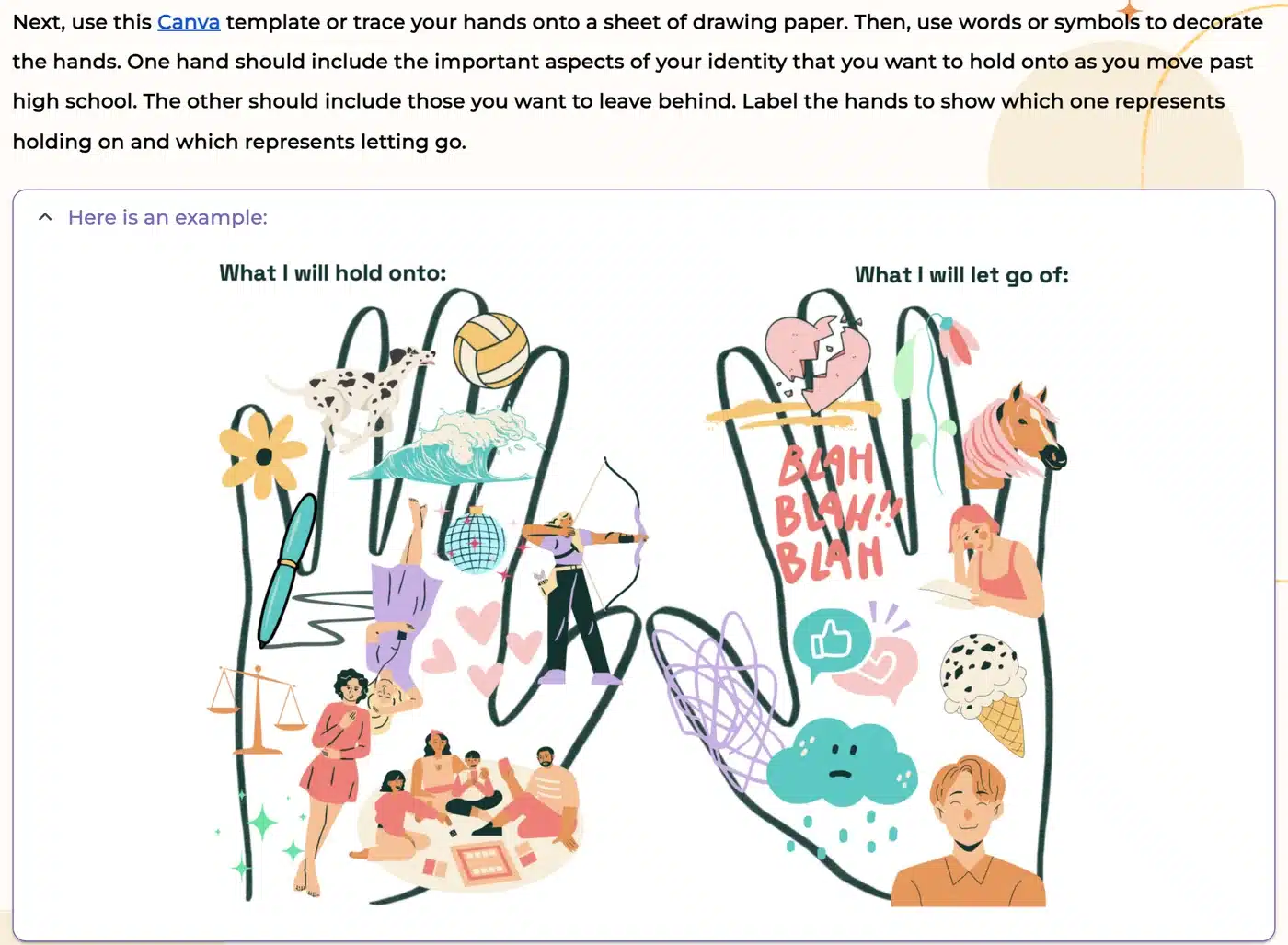
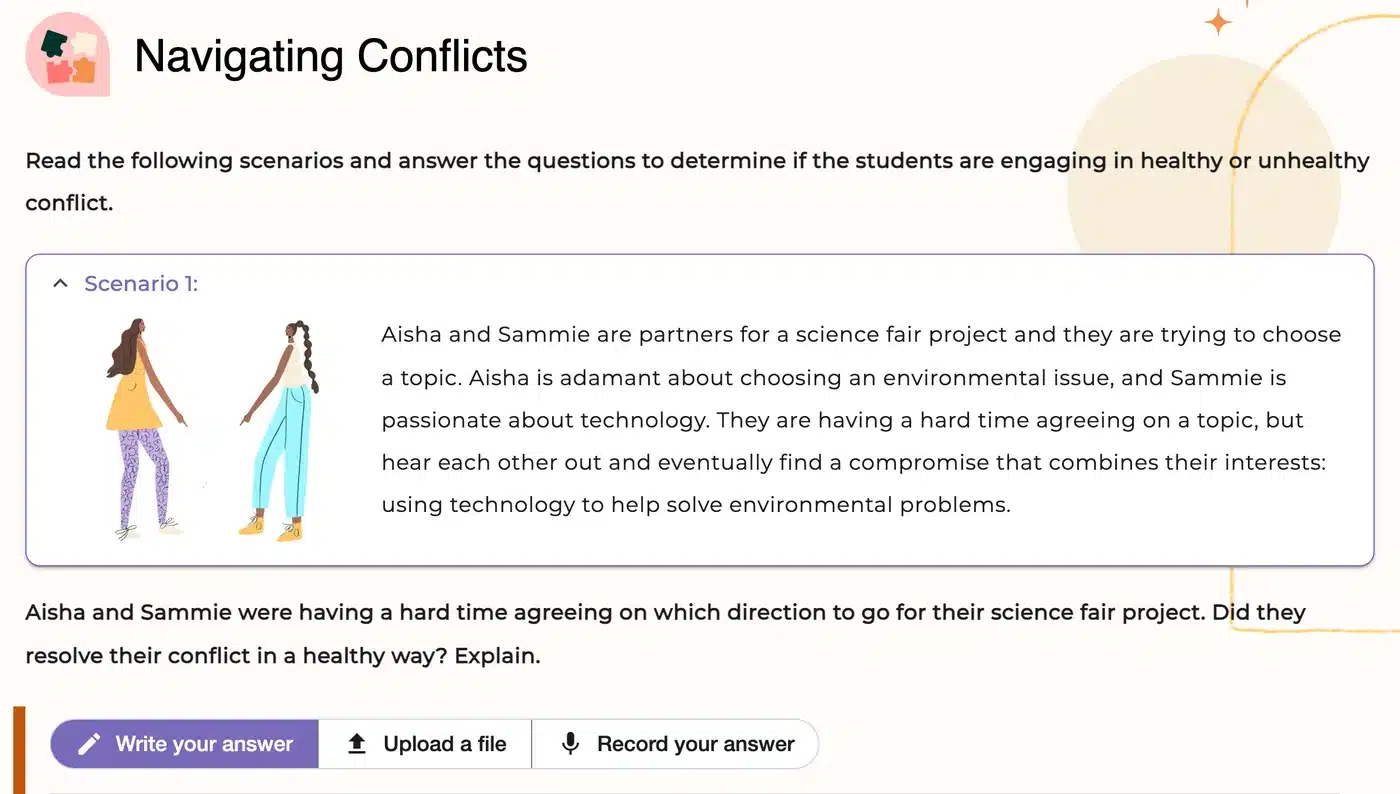
Each lesson moves from goals and a quick pre-check to an opening question, the core ideas, realistic scenarios, a post-check and, in most lessons, a journal reflection. Collaboration boards appear in 95 of the 100 high school lessons.
Core lessons take 20 minutes, with extension activities for longer periods, and fit advisory, homeroom, a health class or a standalone elective. Teachers can lead the whole class, run a live session on students’ devices, or assign lessons for independent work. Every lesson has two ready lesson plans and teacher notes on every page, and the curriculum is designed for minimal prep.
See how lessons work across the SEL curriculum for grades 6–12
Evidence Behind the High School Curriculum
A recent third-party study following ESSA Level III standards included 1,829 students in grades 9–12 in a suburban New Jersey high school district. Students who completed all 25 lessons had 11% higher well-being scores than students who completed 5.
The lessons are built on established research. They follow CASEL’s SAFE practices (sequenced, active, focused and explicit) and the 5E instructional model (Bybee, 1997), apply Universal Design for Learning (Rose & Meyer, 2002) and formative assessment research (Black & Wiliam, 1998), and draw on social learning theory (Bandura, 1977), growth mindset (Dweck, 2006), cognitive behavioral theory (Beck, 1993), positive psychology (Seligman, 2002) and mindfulness practice (Kabat-Zinn, 1994). The 48 pre- and post-assessments across grades 9–12 feed admin reports that compare scores and export to Excel. See the full research basis: Research Basis (PDF).
Awards
- EdTech Breakthrough, SEL Solution of the Year (2024)
Starting in Middle School?
Ori Learning’s Emotional Well-Being Curriculum starts in grade 6, so a district can run one program from middle school through graduation, built on the same five competencies.
Several grade 9 lessons build directly on grade 8. “Building Habits” returns with the Edit–Replace–Stack method, “New Perspectives” leads into “Understanding Perspective”, and “Being Decisive” leads into “Making Decisions” and “Problem Solving”. The SMART goals students first set in grade 8 come back in grades 11 and 12.
Frequently Asked Questions
What does SEL look like in high school?
In high school, SEL is explicit teaching of the skills students need for more independence and bigger decisions: managing stress, building healthy relationships, recognizing bias, setting goals and planning what comes after graduation. In Ori Learning’s curriculum, grades 9, 10, 11 and 12 each have 25 lessons across CASEL’s five competencies, and grade 12 focuses on life after high school.
What topics does the high school curriculum cover?
Grade 9 covers identity, stress, habits, empathy, healthy and unhealthy relationships, and peer pressure. Grade 10 covers values, accepting emotions, burnout, sympathy versus empathy, communication and conflict. Grade 11 covers interests and aspirations, procrastination, SMART goals, bias, boundaries and reputation. Grade 12 covers motivation, leadership, maintaining friendships, big decisions and healthy risks. The scope and sequence lists all 100 lesson titles.
How long are lessons, and where do they fit in the school day?
Core lessons take 20 minutes, with extension activities for longer periods. The curriculum is built to fit advisory or homeroom, a health class, or a standalone elective. Teachers can present to the whole class, run a live session where students follow on their own devices, or assign lessons for students to complete independently. Each lesson includes two ready lesson plans and teacher notes.
What evidence supports it?
A recent third-party study following ESSA Level III standards included 1,829 students in grades 9–12 in a suburban New Jersey high school district. Students who completed all 25 lessons had 11% higher well-being scores than students who completed 5. The lesson design draws on the SAFE and 5E instructional models and research on adolescent development.
What can families see about what students learn?
The scope and sequence is free to download and lists every unit and lesson title, including all 100 high school lessons. The lessons teach skills students use now and after graduation: handling stress, building healthy relationships, making decisions and planning for the future. Districts can share it with families and school boards, so conversations about SEL start from what students are actually taught.
Is it aligned to CASEL?
Yes. Each high school grade has five units, one for each CASEL competency: Self-Awareness, Self-Management, Social Awareness, Relationship Skills and Responsible Decision-Making. The scope and sequence shows which lessons sit under each competency. The alignment is Ori Learning’s own mapping of units and lessons to the CASEL framework, not a designation from CASEL.
See a High School Lesson
Request a demo to walk through a lesson from grade 9, 10, 11 or 12, or download the scope and sequence to see all 100 high school lesson titles.
Curriculum led by Dr. Miriam Gayle, EdD. Originally developed with Tess Hileman, M.Ed., Kate Sundquist, M.Ed., and Tynishia Williams.