
Transition Curriculum for Students with Disabilities
Ori Learning’s transition curriculum is a vertically aligned program for grades 9–12 and adult transition (18–22+) that builds employment skills, independent living, self-determination, and postsecondary readiness—while simplifying planning and documentation.

What is a Transition Curriculum?
A transition curriculum is a structured scope and sequence required within special education that prepares students for life after high school—while supporting Indicator 13 alignment and clearly articulated post-secondary goals. It bridges academic instruction and functional adulthood by focusing on post-school outcomes such as competitive integrated employment, postsecondary education or training, and independent living.
A strong transition curriculum includes:
- Self-determination and goal setting
- Job exploration and workplace readiness
- Daily living and community access skills
- Social/interpersonal and self-advocacy skills
- Progress monitoring and documentation
For general education students in grades 6–12, Ori Learning’s Emotional Well-Being Curriculum builds the social-emotional foundation that complements transition readiness across both programs.
Transition Curriculum Framework: 6 Core Domains
Stop retraining students every time they move up a grade. Our solutions are built on the same 6 Core Domains, ensuring consistent vocabulary from ages 14 through adulthood.
1. Self-Determination
From identifying strengths and limitations (HS) to advocating for workplace accommodations and rights (Adult).
2. Education & Training
From developing study habits and post-secondary plans (HS) to accessing community learning centers and vocational training (Adult).
3. Employment Skills
From career interest surveys and resume building (HS) to workplace safety, hygiene, and job retention (Adult).
4. Independent Living
From understanding leases and financial literacy (HS) to cooking meals, doing laundry, and managing a household (Adult).
5. Interpersonal Skills
From navigating peer pressure and digital communication (HS) to handling conflict resolution in professional settings (Adult).
6. Health & Wellness
From stress management and emotional regulation (HS) to independently managing doctor appointments and prescriptions (Adult).
High School Transition Curriculum
(Grades 9-12)
Focus: College & Career Readiness
A standards-aligned curriculum for students focusing on self-discovery, post-secondary planning, and documented service delivery.
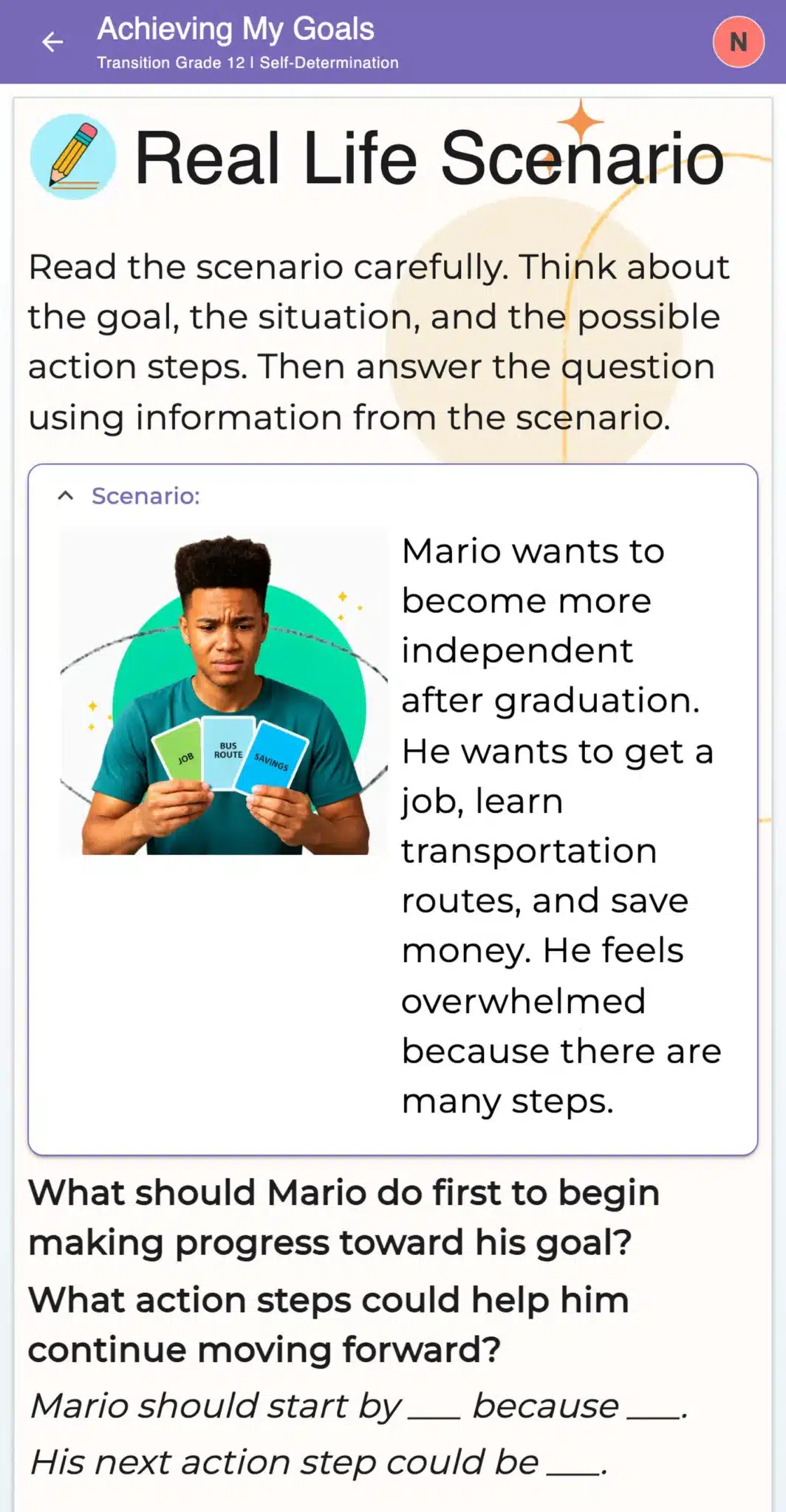
- Indicator 13 Support: Timestamped student responses, assessment results and completion records you can draw on for transition documentation.
- Spiraled Scope & Sequence: Age-appropriate progressions that mature with the student—from Freshman exploration to Senior launch.
- Standards Aligned: Instruction mapped to Common Core ELA and CASEL competencies to ensure academic rigor alongside transition planning.
Adult Transition Curriculum
(18-22+ Programs)
Focus: Functional Independence
A functional curriculum designed to build independence in daily living, employment, and community access.
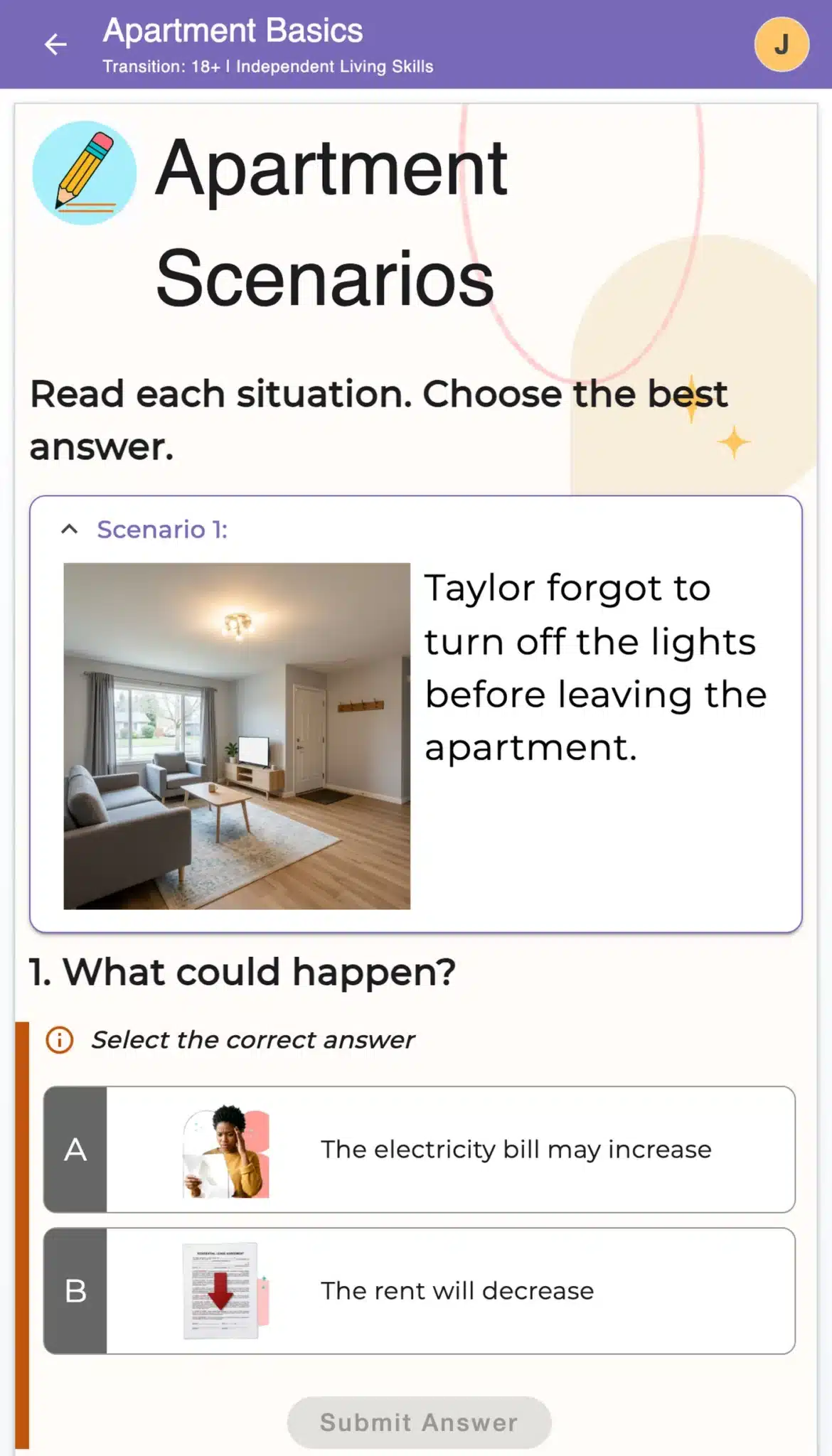
- WIOA & Pre-ETS Aligned: Targeted instruction for Job Exploration and Workplace Readiness to support funding coordination and validate grant reporting requirements.
- Modular Design: Skill-based units (not grade levels) for flexible adult instruction.
- Real-World Application: Practical focus on independent living, safety, financial literacy, and vocational skills to bridge the gap between school and adulthood.
A Vertically Aligned Scope & Sequence
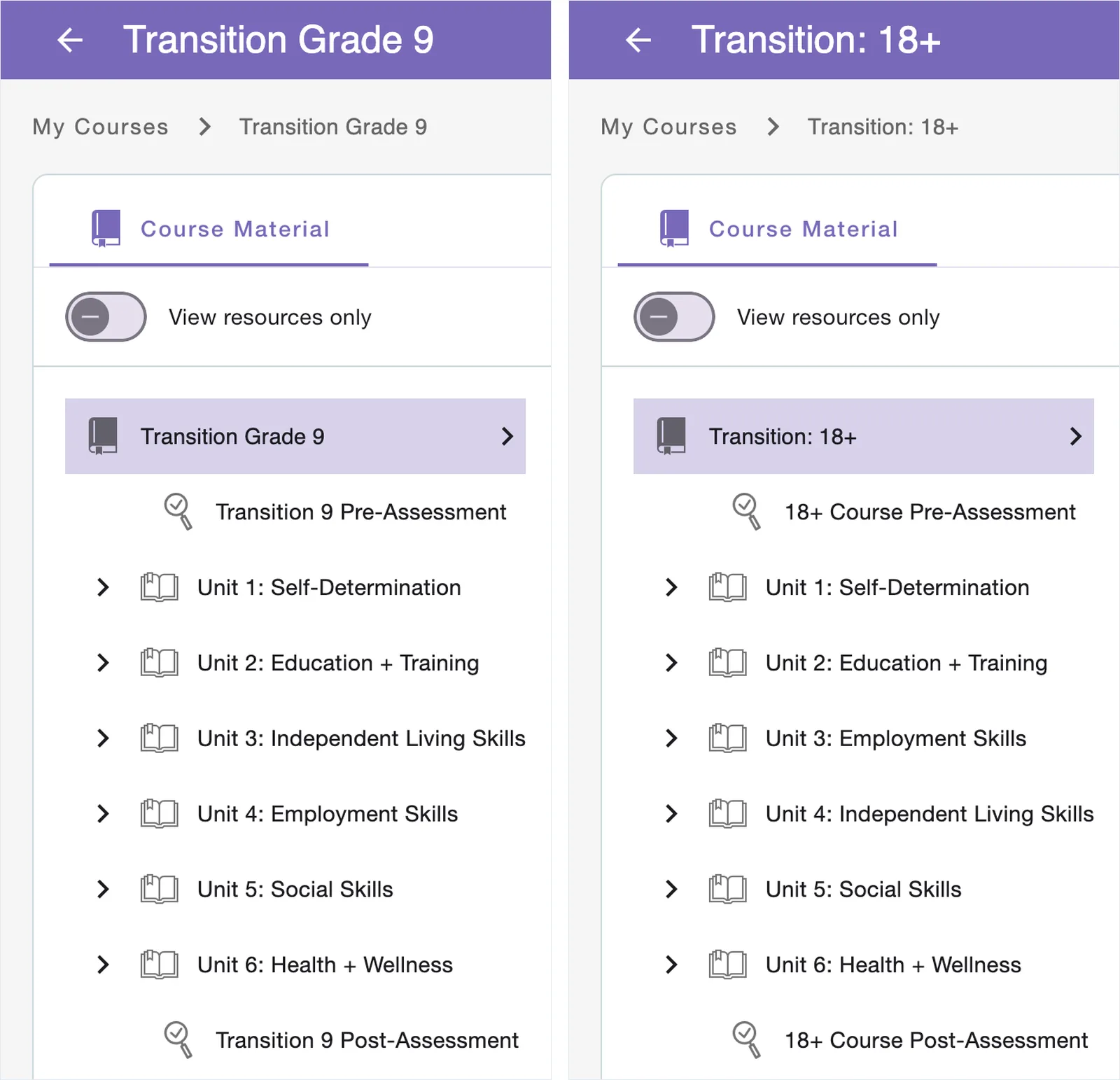
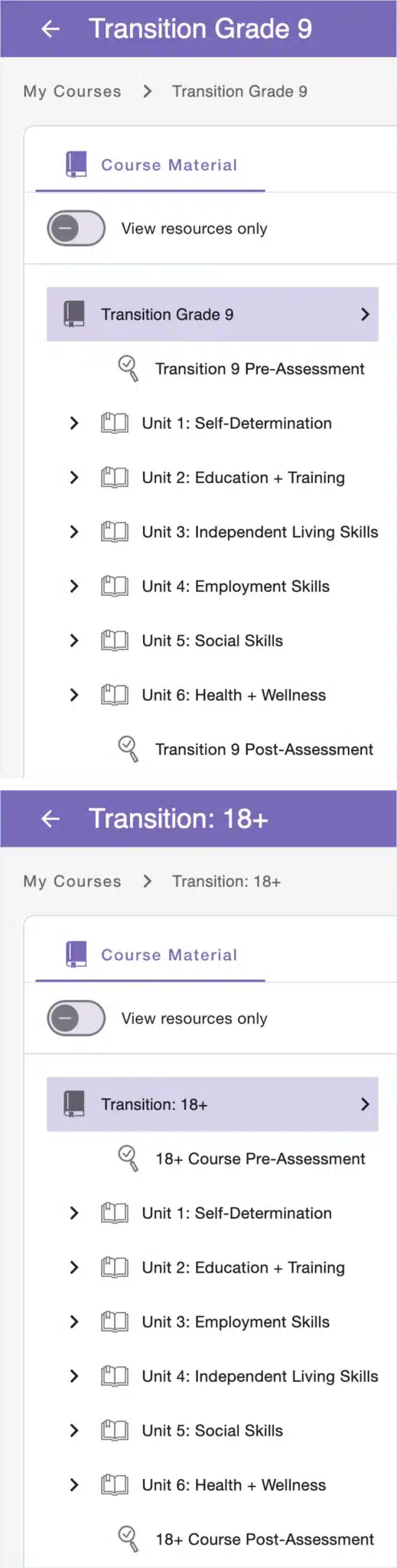
See how our curriculum matures with your students from Grade 9 through Age 22.
Self-Determination
High School Focus (Grades 9-12): Focuses on recognizing strengths and limiting beliefs , and overcoming obstacles to set long-term goals.
Adult Focus (18-22+): Shifts to active leadership, where students learn to lead their own IEP meetings and advocate for their disability rights in housing and employment.
Independent Living
High School Focus (Grades 9-12): Covers foundational routines like personal care, cooking, and keeping a space organized.
- Adult Focus (18-22+): Advances to functional autonomy, including transportation training (reading schedules/maps) , budgeting for rent and utilities , and emergency preparedness.
Employment Skills
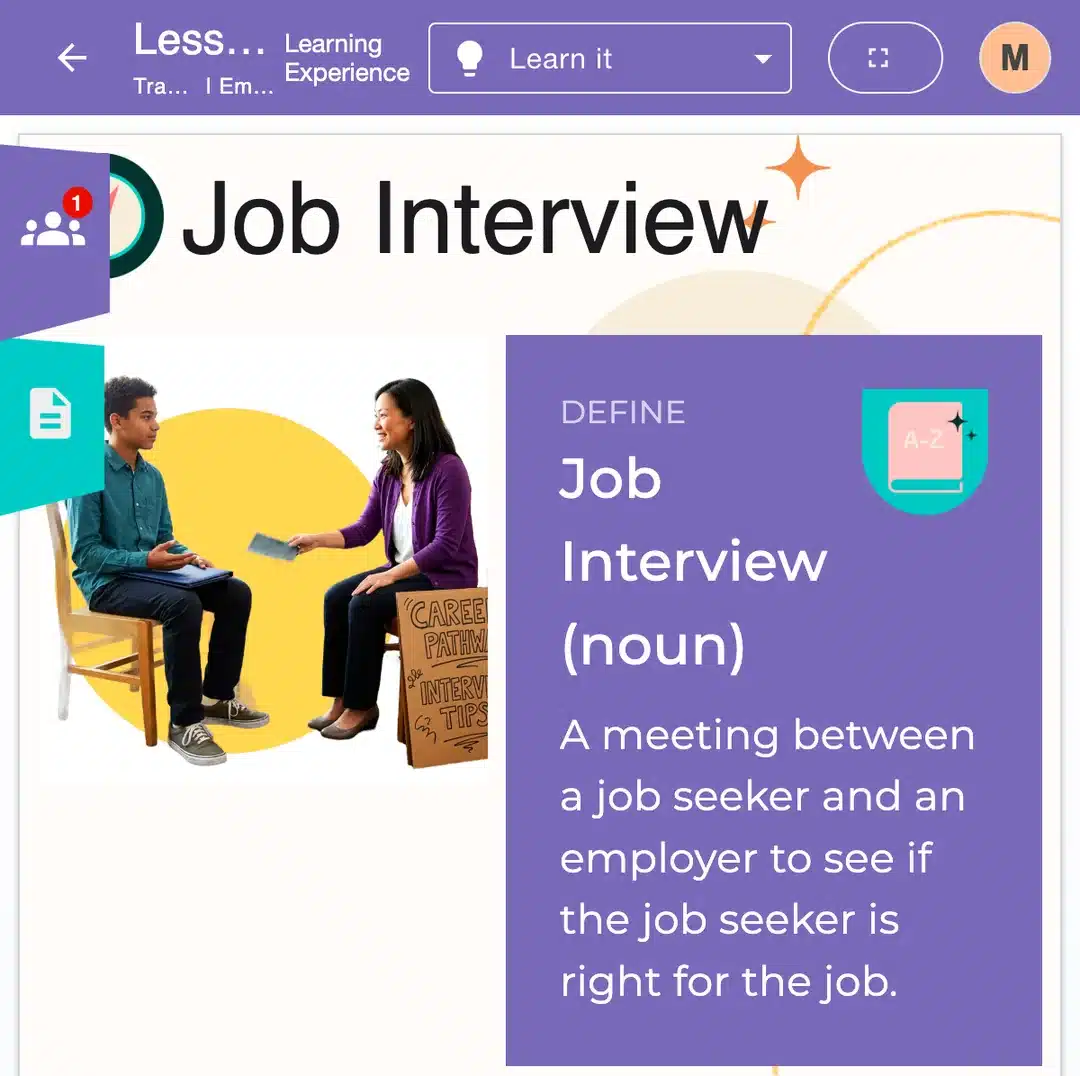
High School Focus (Grades 9-12): Students practice building resumes, filling out applications, and mock interviewing.
Adult Focus (18-22+): Focuses on job retention, including workplace safety, communicating with managers, and understanding work ethic.
Education & Training
High School Focus (Grades 9-12): Students build executive function skills, exploring personal learning styles, study habits, and time management strategies. They learn to navigate accommodations and develop test-taking strategies to support academic success.
Adult Focus (18-22+): The focus shifts to lifelong learning and using technology responsibly. Students explore community training programs and apprenticeships while learning to request and utilize accommodations independently in educational or workplace settings.
Social Skills
High School Focus (Grades 9-12): Instruction focuses on navigating peer pressure, digital citizenship (cyberbullying), and building healthy friendships. Students practice conflict resolution and learn to respect different points of view in a school environment.
Adult Focus (18-22+): Students refine complex social skills needed for adulthood, such as making strong first impressions, understanding personal boundaries, and handling conflict respectfully in professional and community settings.
Health & Wellness
High School Focus (Grades 9-12): Students build self-awareness around mental health, stress management, and hygiene routines. They learn to identify emotions and practice healthy decision-making regarding nutrition and safety.
Adult Focus (18-22+): The curriculum advances to healthcare literacy, where students learn to schedule doctor appointments, understand medications, and create personalized wellness plans that include physical movement and mental health support.
Research & Best Practices
- Guideposts to Success – National Collaborative on Workforce & Disability for Youth
- Effective Practices in Secondary Transition – National Technical Assistance Center on Transition
- Transition IEP Indicator 13 Checklist – National Secondary Transition Technical Assistance Center
- Universal Design for Learning (UDL) –
CAST
Powered by the Ori Learning Platform
Both solutions are built on the same secure, accessible technology to ensure consistency across your district.
Defensible Data & Documentation
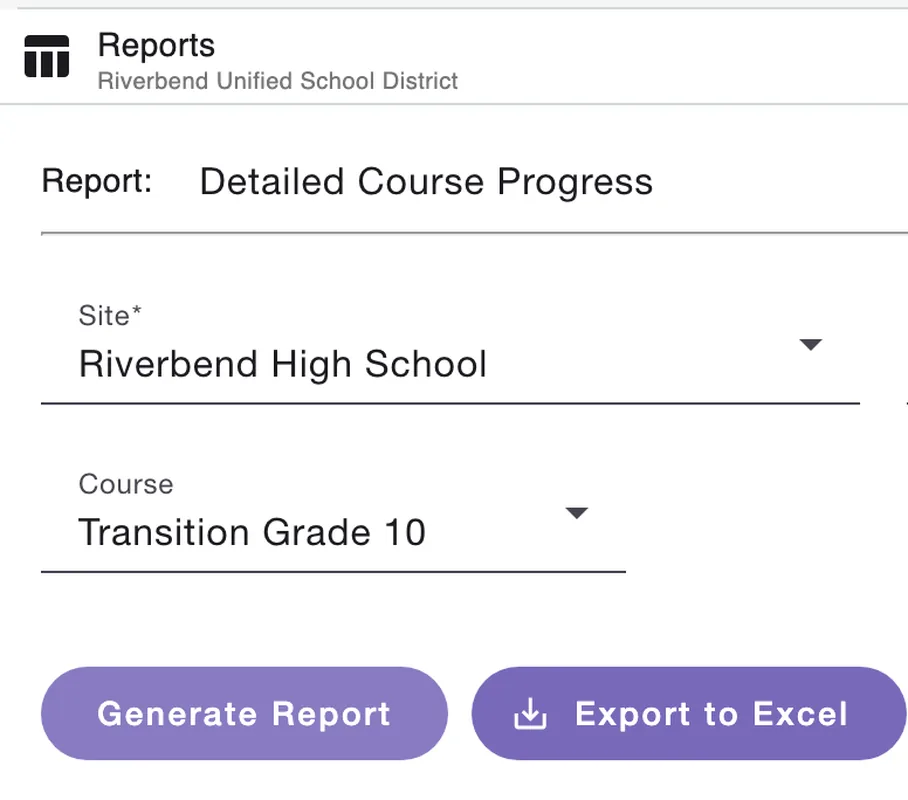
Move beyond simple tracking. Lesson completion and assessment results are recorded for every student and export to Excel, giving you a record to draw on for Indicator 13 and district reporting.
Universal Design for Learning (UDL)
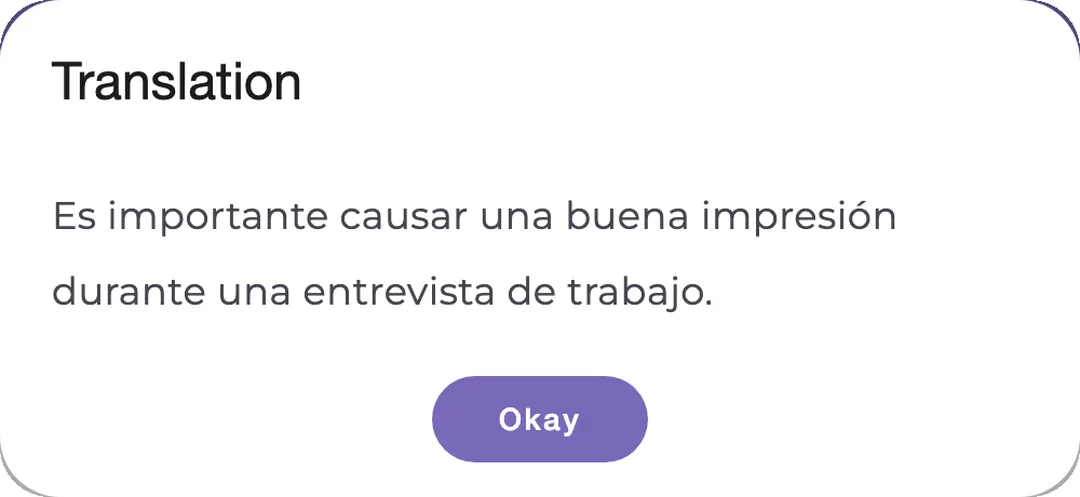
True inclusion requires access. We provide built-in Read Aloud, Zoom, and translation of selected text in 130+ languages, ensuring students with mild-to-moderate needs can demonstrate knowledge their way.
Flexible Delivery Models
Adapt to any setting. Switch instantly between Front-of-Class for group instruction, Student-Paced for independent stations, or Live Participation for interactive engagement—giving teachers full control of the room.
How Districts Budget for Ori Learning
Because the Transition Curriculum supports IEP transition requirements, districts commonly fund it through IDEA (special education) and federal Title funds tied to college-and-career readiness. We’ll help you identify the right funding source for your program.
Transition Curriculum FAQ
What is a transition curriculum?
A transition curriculum is a structured set of lessons and activities designed to help students with disabilities prepare for life after high school. It covers skills in employment, postsecondary education, independent living, self-advocacy, and community participation. Under the Individuals with Disabilities Education Act (IDEA), transition planning must be included in a student’s IEP by age 16 — and a transition curriculum provides the instructional content to support those goals.
What are the 6 core domains of a transition curriculum?
Ori Learning’s transition curriculum is built around six core domains that address the full range of skills students need for adult life:
- Self-Determination — Self-awareness, self-advocacy, goal setting, and decision-making
- Education & Training — Study skills, organization, learning supports, and postsecondary planning
- Employment Skills — Job search, resume building, interviews, workplace behavior, and career readiness
- Independent Living — Daily routines, meal preparation, household management, and community navigation
- Interpersonal Skills — Communication, teamwork, relationship building, and conflict resolution
- Health & Wellness — Mental health, physical health, emotional regulation, and nutrition
What does IDEA require for transition planning?
The Individuals with Disabilities Education Act (IDEA) requires that transition planning begin no later than the first IEP in effect when a student turns 16 (many states require it by age 14). The IEP must include measurable postsecondary goals in education/training, employment, and (where appropriate) independent living, along with transition services to help the student reach those goals. A transition curriculum provides the structured instructional content to support this process.
What is the difference between transition planning and a transition curriculum?
Transition planning is the IEP-driven process of setting postsecondary goals and identifying services for a student with a disability. A transition curriculum is the instructional content — the lessons, activities, and assessments — that teaches the skills those goals require. Transition planning determines what a student needs; a transition curriculum provides how they learn it.
At what age does transition curriculum begin?
IDEA requires transition planning in the IEP by age 16, though many states mandate it by age 14. Ori Learning’s high school transition curriculum begins in grade 9, giving students four full years to build skills across six domains before graduation. The adult transition curriculum (ages 18–22+) continues skill development for students who remain in school-based programs after high school. Learn about the high school transition curriculum or explore the adult transition curriculum.
What is the difference between high school transition and 18+ transition curriculum?
High school transition curriculum (grades 9–12) focuses on exploration, planning, and building foundational skills in career awareness, self-determination, and independent living. It emphasizes group discussion (80% of lessons) and collaborative learning. Adult transition curriculum (ages 18–22+) shifts to applied independence — self-advocacy, IEP participation, job readiness, and community-based skills. 97% of adult lessons include journal reflection for self-directed learning. Both share the same six-domain framework, ensuring vertical alignment from high school through adulthood.
How is transition curriculum funded in public schools?
Transition curriculum can be funded through several federal and state mechanisms: IDEA Part B special education funds, Pre-Employment Transition Services (Pre-ETS) under WIOA for eligible students, state special education allocations, and in some cases remaining ESSER funds. Programs serving students ages 18–22 often leverage vocational rehabilitation (VR) partnerships and WIOA Title IV funding to support curriculum purchases and implementation.
What evidence-based practices should a transition curriculum include?
According to the National Technical Assistance Center on Transition (NTACT:C) and research by Test et al., effective transition curricula should include self-determination instruction, career and vocational education, community-based instruction, and explicit teaching of social and independent living skills. Ori Learning incorporates evidence-based frameworks including Universal Design for Learning (UDL), Carol Dweck’s Growth Mindset, and SMART Goals methodology, with pre/post assessments in every lesson to measure student outcomes.
Explore Transition Curriculum Resources
Curriculum pages:
- High School Transition Curriculum (Grades 9–12) — 168 lessons across six domains
- Adult Transition Curriculum (Ages 18+) — 60 lessons with Pre-ETS alignment
- Download the Transition Scope & Sequence — Review units, lessons, and standards alignment
- See district success stories → — Real results from districts using Ori Learning
From the blog:
- How to Choose a Transition Curriculum for Your School or District
- Transition Skills for High School Students: Why They Matter
- Case Study: Fairfax County Public Schools
- Case Study: RMA Public Schools — 100% Staff Buy-In
Curriculum led by Dr. Miriam Gayle, EdD. Originally developed with Tess Hileman, M.Ed., Kate Sundquist, M.Ed., and Tynishia Williams. Last reviewed May 2026.