Why Self-Identity Activities Matter in High School
Identity development and academic achievement reinforce each other. A decade-long review in the Journal of Research on Adolescence found that higher academic achievement predicted stronger identity commitments, while identity development positively influenced students’ motivational beliefs about mastering coursework (Branje et al., 2021). The Search Institute’s Developmental Assets Framework reinforces this connection — Positive Identity is one of four internal asset categories, and young people with more developmental assets are more likely to thrive academically and less likely to engage in high-risk behaviors (Search Institute).
The developmental science supports this pattern. Erik Erikson identified adolescence as the stage when students actively construct their sense of self — what he described as the tension between ego identity and identity confusion (Orenstein & Kaur, 2026). Students who navigate this stage develop what Erikson called fidelity: the ability to commit to values, relationships, and goals even under social pressure.
Identity activities don’t require a dedicated course. They fit advisory periods, life skills classes, homeroom blocks, and small-group counseling sessions. What they require is intentional time for structured reflection.
In the CASEL framework, identity exploration is foundational to Self-Awareness — the first of five core competencies. CASEL lists “integrating personal and social identities” as the first skill under Self-Awareness, positioning identity work as the starting point for all other social-emotional learning.
Key Takeaways:
- 12 classroom-ready activities designed for grades 9-12 advisory, life skills, and counseling settings
- Each activity takes 20-45 minutes and includes an objective, materials, directions, and a reflection prompt
- Identity work aligns with CASEL Self-Awareness — the foundation of social-emotional learning
- Adaptation tips included for multilingual learners and students with disabilities
12 Self-Identity Activities for the Classroom
Each activity below includes an objective, materials list, directions, and a reflection prompt. All are designed for a single class period (20-45 minutes) and work in advisory, life skills, homeroom, or counseling settings.
The most versatile options for advisory and life skills blocks include Identity Maps for self-concept exploration, Values Ranking for articulating priorities, the Ikigai Framework for purpose and career connection, and Strength Spotting for evidence-based self-assessment. All 12 activities align with the CASEL Self-Awareness competency. Most can be facilitated by classroom teachers using standard discussion norms, though activities involving identity, privilege, or personal disclosure benefit from the facilitation guidance in the section below.
1. Identity Map
Objective: Visualize the multiple dimensions of personal identity.
Materials: Large paper or digital whiteboard, markers
How it works: Students place their name at the center of a blank page and draw branches outward representing roles (sibling, teammate, student), values (honesty, creativity), interests (music, gaming, science), and key relationships. Each branch gets 2-3 specific examples. After completing their maps, partners compare and identify one shared element neither expected.
Reflection prompt: Which part of your identity feels most important to you right now — and has that changed in the last year?
2. “Who Am I?” Meme Challenge
Objective: Express identity through a familiar, low-stakes digital format.
Materials: Devices with meme generator access (Canva, Imgflip), projector
How it works: Students select 3-5 meme templates and use them to communicate something real about themselves — a value, a habit, a cultural reference, or a goal. Each meme includes a brief caption explaining the identity connection. Display all memes in a gallery walk. Because students are already familiar with meme formats, this activity can feel lower-stakes than a full written reflection — especially useful in advisory or mixed-engagement groups.
Reflection prompt: What did your meme choices reveal about what you find funny, important, or true about yourself?
3. Values Ranking
Objective: Identify and prioritize core personal values.
Materials: Printed values cards (20-25 values) or a digital list
How it works: Distribute cards with words like honesty, adventure, family, justice, creativity, independence, and faith. Students sort them into three tiers: essential, important, and less important — then narrow to their top 3. In small groups, each person shares their top 3 and explains one choice. This activity surfaces values students may never have articulated before.
Reflection prompt: Was it harder to pick your top 3 or to let go of the ones you cut?
4. Letter to My Future Self
Objective: Connect present identity to future aspirations.
Materials: Paper or digital document, envelopes (optional for end-of-year return)
How it works: Students write a letter addressed to themselves one, five, or ten years from now covering three areas: who they are right now, what they hope stays the same, and what they want to change. Teachers can collect sealed letters and return them at year’s end.
Reflection prompt: What would your future self need to hear from you today?
5. Strength Spotting
Objective: Name personal strengths using evidence from real experiences.
Materials: Character strengths list (VIA Institute’s 24 strengths), partner pairing
How it works: Students review a list of 24 character strengths — courage, humor, kindness, curiosity, perseverance, among others — and select 5 they believe describe them. For each, they write one specific moment they demonstrated it. Partners then review each other’s lists and add one strength the other person missed. Partner feedback helps students notice strengths they may overlook in self-assessment.
Reflection prompt: Did your partner spot a strength you hadn’t noticed? What does that tell you about how others see you?
6. Cultural Identity Timeline
Objective: Trace identity-shaping experiences across a lifetime.
Materials: Long paper strip or digital timeline tool (Google Slides, Canva)
How it works: Starting from birth, students mark 8+ moments that shaped who they are: a family tradition, a move, learning a language, a defining school experience, a cultural practice they value. Each entry gets a short label and a one-sentence explanation. Students present one entry to a small group and explain its significance.
Reflection prompt: Which experience on your timeline had the biggest influence on how you see yourself today?
7. Invisible Knapsack Reflection
Objective: Examine how identity shapes daily access and perspective.
Materials: Adapted checklist of daily-experience statements, journal
How it works: Provide students with an age-appropriate checklist of statements about everyday experiences (e.g., “I can find bandages that match my skin tone,” “I see people who look like me represented on TV regularly”). Students privately check which statements apply. The class then discusses patterns collectively — never individual answers — exploring how identity factors like race, language, ability, and geography shape daily life. Keep the tone inquiry-based.
Reflection prompt: What is one thing you learned about an experience different from your own?
8. Ikigai Framework
Objective: Explore the intersection of passion, skill, and purpose.
Materials: Ikigai diagram handout (four overlapping circles), markers
How it works: Introduce the Japanese concept of ikigai — roughly, “a reason for being.” Students fill in four circles: what I love, what I’m good at, what the world needs, and what I could be paid for. Where circles overlap, students identify potential career paths, volunteer interests, or personal projects. Juniors and seniors thinking about post-secondary plans find this especially grounding.
Reflection prompt: Where did your circles overlap the most — and what surprised you about the gaps?
9. Growth Mindset Identity Statement
Objective: Reframe fixed self-beliefs into growth-oriented statements.
Materials: Two-column worksheet (“Fixed” / “Growth”), displayed examples
How it works: Students list 3-5 statements they believe about themselves that feel permanent: “I’m bad at math,” “I’m shy,” “I’m not a leader.” For each, they rewrite using growth language — “I haven’t found my math strategy yet,” “I’m building confidence speaking up in groups.” Pairs share one rewrite and coach each other on making the new statement specific and believable.
Reflection prompt: Which fixed belief was hardest to rewrite — and why do you think it stuck?
10. Peer Mirror Activity
Objective: See yourself through a classmate’s perspective.
Materials: Index cards, pens
How it works: Pair students with someone they know reasonably well. Each partner writes 5 positive, specific observations about the other — behaviors, not vague compliments. “You always check in when someone seems off” carries more weight than “you’re nice.” Partners exchange cards and read silently, then discuss: which observation surprised them, and which confirmed something they already knew.
Reflection prompt: Is there a difference between how you see yourself and how others see you? What might explain that gap?
11. Identity Shield
Objective: Organize identity dimensions into a visual framework.
Materials: Shield template (divided into 4 quadrants), art supplies or digital tools
How it works: Each quadrant represents a different identity dimension: a value I stand for, a strength I rely on, a person who shaped me, and a goal that drives me. Students fill each section with images, symbols, or words. A banner across the bottom holds a personal motto. Display completed shields in the classroom so students can reference them throughout the year.
Reflection prompt: If you could add a fifth section to your shield, what would it represent?
12. Aspiration Wall
Objective: Link future goals to underlying values and identity.
Materials: Butcher paper or whiteboard, sticky notes, markers
How it works: Students complete the sentence “One day, I want to ___” on sticky notes and post them to a shared class wall. After everyone contributes, the class looks for patterns: do most aspirations center on achievement, relationships, experiences, or impact? Students then write a short paragraph connecting their response to a value they hold. This activity reveals identity through future orientation — what students reach toward says as much about who they are as what they’ve already experienced.
Reflection prompt: What does your aspiration say about what you value most right now?
This is just one piece. See the full curriculum scope.
Our Emotional Well-Being Curriculum covers this topic and dozens more across grades 6-12, with research-backed lessons ready to use in your classroom.
How to Facilitate Identity Work Safely and Inclusively
Identity activities can surface sensitive material — family dynamics, cultural tension, disability, gender, and socioeconomic status all intersect with self-concept. Preparation matters more than the activity itself. Start by establishing group norms before the first exercise. Co-create agreements with your class: listen without judgment, respect that sharing is voluntary, and keep personal disclosures within the room. Post the norms visibly and revisit them each session.
Even with strong norms, not every student will be ready to share publicly. Journaling, drawing, audio recording, and partner-only conversations all count as meaningful reflection. Students who opt out of sharing should still engage privately — the goal is self-exploration, not performance. For multilingual learners specifically, allow responses in a student’s home language first. For students with disabilities, adapt the expression format without altering the reflective intent — visual organizers, recorded verbal responses, and paired sharing all preserve the purpose of the activity. (See the “Adapting Activities for Diverse Learners” section below for specific strategies.)
Your role as a facilitator is to create the container, not direct the conclusions. If a student shares something concerning, follow your school’s referral protocol. The ASCA Mindsets and Behaviors standards emphasize that school counselors support students in developing “a sense of acceptance, respect, support and inclusion for self and others” — identity activities are one pathway to that standard.
Reflection Questions and Discussion Prompts
Use these prompts to extend identity conversations beyond the 12 activities above. They work as journal entries, advisory discussion starters, or exit ticket questions.
- What is one value that guides most of your decisions?
- How has your identity changed in the last two years?
- What parts of your identity do you show at school versus at home?
- What does it mean to be true to yourself when others disagree with your choices?
- Who are the people who know you best — and why them?
- What is one thing you wish your teachers understood about you?
- When have you felt most confident in who you are?
- What role does your cultural background play in how you see yourself?
- Describe a time when you changed your mind about something important.
- If you could be remembered for one thing, what would it be?
Adapting Activities for Diverse Learners
Students with disabilities and multilingual learners benefit from the same identity work — they need flexible pathways to engage with it.
For students with language processing challenges, offer text-and-image-based alternatives. An Identity Shield can use photographs or magazine clippings instead of written descriptions. A Cultural Identity Timeline can rely on drawings or symbols at each milestone.
Verbal and recorded response options help students who struggle with written expression. Pair reflections — where one student speaks while a partner records key points — give students agency without requiring independent written output.
Finally, small-group variants prevent disengagement during individual reflection. For example, a Values Ranking done in pairs generates richer conversation than a solo exercise. The Peer Mirror Activity is collaborative by design.
Ori Learning’s Emotional Well-Being Curriculum includes built-in accommodations that support these adaptations across all lessons: text-to-speech with adjustable playback speed, translation into 136 languages, adjustable zoom, and speech-to-text for all open-ended responses.
Free Lesson Download
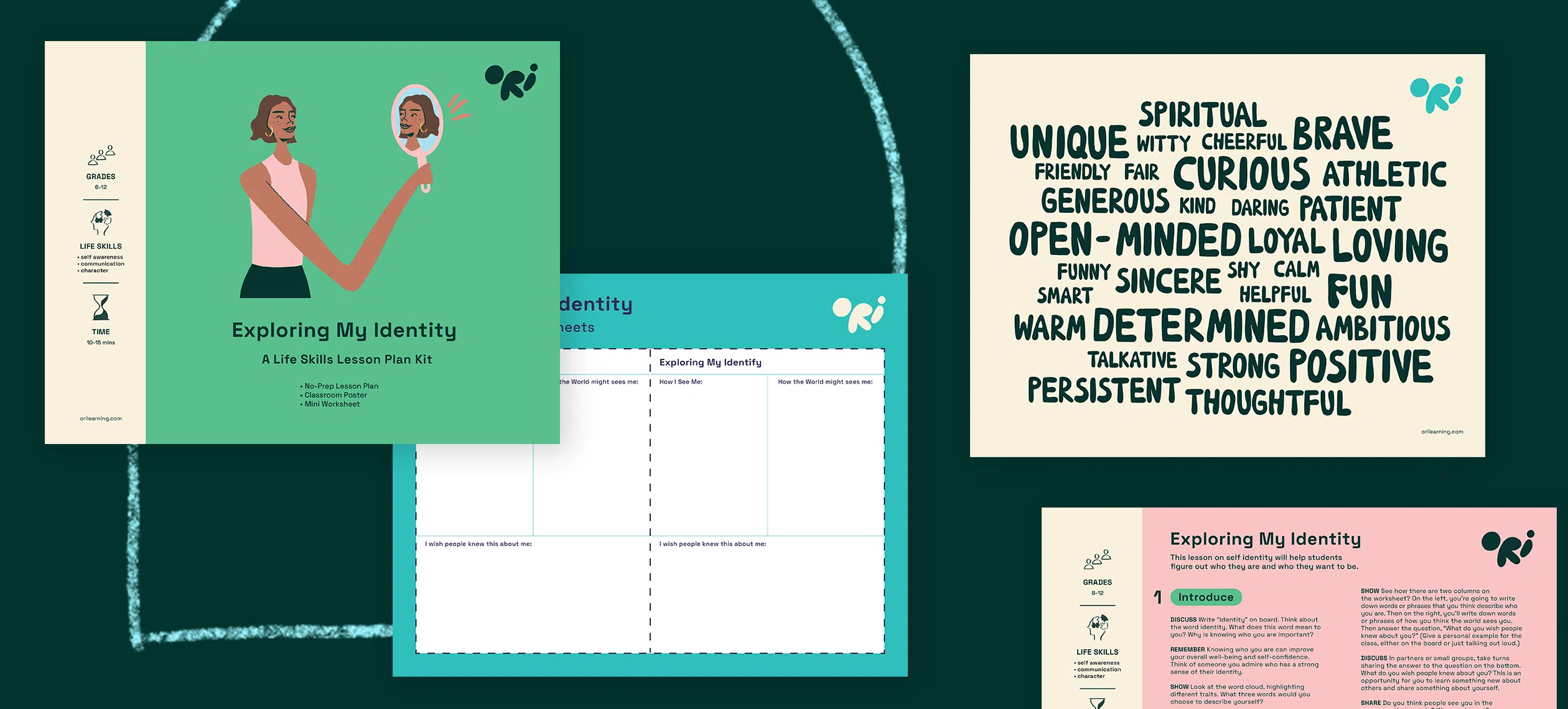
Want to try a structured self-identity lesson with your students? Download Ori Learning’s free self-identity activity — a classroom-ready lesson that walks high school students through a guided reflection on values, strengths, and personal goals. The download includes a teacher guide, student handout, and discussion prompts designed for a single class period.
Related Curriculum Supports
Self-identity activities are a starting point. For schools building sustained life skills programming, two Ori Learning resources connect directly to the work above.
The Emotional Well-Being Curriculum, an SEL curriculum, organizes 25 lessons per grade level (grades 6-12) around the five CASEL competencies. Unit 1 — Self-Awareness — is where identity work lives. Students explore self-concept, personal strengths, values, and growth mindset through interactive digital lessons with built-in collaboration boards and reflection journals.
For special education settings, the Transition Curriculum for Students with Disabilities includes a Self-Determination unit that helps students articulate their identity, strengths, and post-secondary goals — critical groundwork for transition planning and self-directed IEP participation.
FAQs
What are self-identity activities for high school students?
Self-identity activities are structured classroom exercises that help high school students explore their values, strengths, cultural background, and personal goals. They are commonly used in advisory, life skills, and school counseling settings to support the CASEL competency of Self-Awareness.
What grade level are these activities appropriate for?
These activities are designed for grades 9–12, though many can be adapted for grade 8 with minor scaffolding. They work well in advisory periods, life skills classes, homeroom, and counseling groups.
How do I adapt self-identity activities for students with disabilities?
Offer multiple response modes — writing, drawing, recording, or verbal sharing with a partner. Use visual organizers for students who benefit from structured formats. For multilingual learners, allow responses in their home language first. The key is removing barriers to expression, not altering the reflective intent of the activity.
How long do self-identity activities typically take?
Most activities in this guide are designed for a 20–45 minute class period. Shorter activities like Values Ranking or Reflection Questions can fit a 15-minute advisory block. Deeper activities like Letter to My Future Self or the Ikigai Framework work best with a full class period plus a follow-up session.
How does self-identity work connect to SEL and life skills curricula?
Self-identity exploration is the foundation of Self-Awareness — one of the five CASEL competencies. A structured life skills curriculum builds on identity work by connecting students’ strengths and values to relationship skills, decision-making, and goal-setting across all grade levels.
Citations
- Orenstein, G. A., & Kaur, J. (2026). Erikson’s Stages of Psychosocial Development. StatPearls. National Library of Medicine. https://www.ncbi.nlm.nih.gov/books/NBK556096/
- CASEL. (2024). What Is the CASEL Framework? https://casel.org/fundamentals-of-sel/what-is-the-casel-framework/
- Search Institute. (2024). Developmental Assets Framework. https://searchinstitute.org/resources-hub/developmental-assets-framework
- Branje, S., de Moor, E. L., Spitzer, J., & Becht, A. I. (2021). Dynamics of Identity Development in Adolescence: A Decade in Review. Journal of Research on Adolescence, 31(4), 908-927. https://pmc.ncbi.nlm.nih.gov/articles/PMC9298910/
- American School Counselor Association. (2024). ASCA Student Standards: Mindsets and Behaviors for Student Success. https://www.schoolcounselor.org/Standards-Positions/Standards/ASCA-Mindsets-Behaviors-for-Student-Success
- VIA Institute on Character. (2024). Character Strengths. https://www.viacharacter.org/character-strengths