

Reviewed by Dr. Miriam Gayle, EdD
Coping strategies are skills students use to handle stress, either by changing the situation or by changing how they respond to it. Planning a study schedule changes the situation; slowing your breathing before a test changes the response. Both can be taught, practiced and improved, like any other classroom skill.
The need is real, though the trend is moving the right way. In the CDC’s 2025 Youth Risk Behavior Survey, 33% of US high school students reported persistent feelings of sadness or hopelessness, down from 40% in 2023.
Below are eight coping strategies for students in grades 6–12, each with a teacher script and a middle school and high school example. You’ll also find classroom routines, a free printable coping plan, and guidance on when a student needs more than a strategy.
What are coping strategies? Healthy vs. unhealthy coping
Coping strategies are the things students do or think on purpose to handle stress. Two common ways to group them are problem-focused coping, which changes the situation, and emotion-focused coping, which changes the response.
- Problem-focused coping changes the situation. Students make a plan, break a big task into steps or ask for help. Example: a student with three assignments due Friday lists them and starts with the one due first.
- Emotion-focused coping changes the response. It works alongside a plan, and it’s especially useful when the situation can’t change, or can’t change yet. Students slow their breathing, name the feeling, reframe a thought or let a feeling be there without fighting it. Example: a student waiting on tryout results can’t change the list, but can notice a tight chest and breathe through it.
Coping strategies sit inside what CASEL calls self-management, which includes the capacity to manage stress. SEL programs taught over time have a solid evidence base: a 2023 meta-analysis of 424 studies found that students in school-based SEL programs showed, on average, improved skills, attitudes, behaviors and academic achievement. That finding is about whole programs; the strategies below are classroom skill practice. For the bigger picture, see how SEL supports emotional regulation.
| Healthy coping | Unhealthy coping |
|---|---|
| Planning ahead and breaking work into steps | Avoiding a task, class or situation because it makes you anxious |
| Naming the feeling and letting it pass | Rumination: replaying the same worry again and again |
| Asking a trusted adult or friend for help | Shutting down or pulling away from everyone |
| Calming the body with breathing, grounding or movement | Using alcohol, vaping or other substances to escape |
The avoidance trap. One distinction matters more than any other. Planning ahead to reduce stress you can control is healthy: spreading out study time is good coping. Escaping what makes you anxious is not. Skipping the presentation feels better right away, and it tends to make the anxiety stronger the next time. That’s why breaks and calm-down spaces need a plan to come back, and why one of the eight strategies below is about facing hard things in small steps.
8 coping strategies to teach middle and high school students
The eight coping strategies: paced breathing, name the feeling, 5-4-3-2-1 grounding, reframe the thought, break it down and prioritize, face it in small steps, ask for help, and make space for the feeling (R.A.I.N.).
Together they make a practical list of coping skills for teens and preteens. The first three help calm the body and steady attention. The next four change the thinking or the situation. The last is for feelings that don’t go away on command.
Paced breathing
- What it is: Slow breathing with a longer breath out than in: in through the nose for 4, out through the mouth for 6. Five rounds take about a minute.
- Why it helps: A long, slow exhale can help settle the body, which can make it easier to think.
- Time to teach: 10 minutes the first time; 1 minute of daily practice.
- Teacher script: “Before a big meeting my heart races, so I breathe in for four (count with me) and out slowly for six, like I’m cooling hot soup. After a few rounds my shoulders drop. Let’s do three together.”
- Middle school example: A sixth grader does three rounds at her locker before a math test.
- High school example: A junior breathes four in, six out in the hallway before a presentation.
- Make it work for more students: Post a “4 in, 6 out” card, or let students trace a finger up on the breath in and down on the breath out. Shorter counts are fine; don’t hold or force the breath, and anyone who feels dizzy stops. Eyes stay open, and anyone can watch instead.
Name the feeling
- What it is: Notice where stress shows up in the body (a tight jaw, hot face, knotted stomach), then name the emotion precisely: “frustrated,” “embarrassed” or “nervous,” not just “bad.”
- Why it helps: A precise word turns a vague wave of stress into something a student can describe and respond to.
- Time to teach: 10 minutes; 30-second check-ins after that.
- Teacher script: “When my inbox fills up, my jaw clenches before I notice I’m upset. So I ask: what’s the body signal, and what’s the word? Jaw tight… I’m overwhelmed, not angry. That means I need a plan.”
- Middle school example: A seventh grader feels her cheeks burn after a teammate’s comment and writes “embarrassed” on a sticky note instead of snapping back.
- High school example: A tenth grader realizes his stomachache before chemistry is dread about the lab and asks to review the procedure.
- Make it work for more students: Offer a feelings word bank or body-outline card, and let students start from a thought clue if body signals are hard to notice. A new or severe physical symptom may not be stress; send the student to the nurse. English learners can name the feeling in their home language first. More practice: our emotion identification worksheets.
5-4-3-2-1 grounding
- What it is: For moments of acute overwhelm, students silently name five things they can see, four they can touch, three they can hear, two they can smell and one they can taste.
- Why it helps: Moving through the senses can pull attention out of a spiraling thought and back into the room.
- Time to teach: 10 minutes; practice once or twice a week while calm.
- Teacher script: “When my thoughts race, I come back to this room. Five things I see: the clock, the window, the red marker… Four I can touch: the desk, my sleeve… I’m not stopping the worry. I’m giving my brain something else to hold.”
- Middle school example: A sixth grader whose mind goes blank when called on to read aloud counts five things she can see, then starts reading.
- High school example: A senior whose chest tightens when a college portal crashes runs through the senses before trying again.
- Make it work for more students: Shorten it to 3-2-1 for tight moments, and skip any sense that’s unavailable or uncomfortable. It works eyes open and in silence, so no one has to know.
Reframe the thought
- What it is: Catch the first thought about a stressful moment and rewrite it on a T-chart: “first thought” on the left; on the right, a “helpful thought” that’s still true, plus one next step. Often that means seeing stress as a challenge you can meet, not a threat.
- Why it helps: In six randomized experiments with US secondary and college students, a 30-minute online lesson teaching that the stress response can help you perform and that abilities can grow improved how students appraised stress and how their bodies responded. It tested that lesson, not this T-chart.
- Time to teach: 20 minutes with a T-chart; one example a week.
- Teacher script: “My first thought about my new schedule was ‘This is impossible.’ True? Not quite. Helpful thought: ‘This is a lot, and my racing heart means I’m gearing up. What’s the first piece?'”
- Middle school example: “Everyone will laugh at my science fair poster” becomes “Most people will be busy with their own posters. I’ll practice explaining mine once tonight.”
- High school example: “If I bomb the SAT, my future’s over” becomes “This test matters, and I can retake it if I need to. Tonight I’ll do one practice section.”
- Make it work for more students: Give sentence starters (“This is hard, and…”) or three helpful thoughts to choose from. Never ask students to reframe bullying, discrimination or an unsafe situation; deal with the situation. More practice: our growth mindset activities.
Break it down and prioritize
- What it is: For students juggling too much: list everything, mark what’s due first and what matters most, and pick one next step. Saying no and setting limits count as healthy strategies.
- Why it helps: Writing it all down makes the load clearer and shows a first step, something to ask about or something to drop.
- Time to teach: 15 minutes; a 3-minute weekly planning check.
- Teacher script: “My week: grading, two meetings, my kid’s game, a report. It all feels urgent. So I mark what’s due first, star what matters most and cross off one thing I can say no to. Next step: the first ten essays.”
- Middle school example: A seventh grader with a project, a quiz and a game studies for tomorrow’s quiz first and tells a friend she can’t hang out until Saturday.
- High school example: An eleventh grader with a part-time job ranks her assignments and asks her manager to drop one shift during finals.
- Make it work for more students: Offer a Now / Next / Later template. For students who need support with planning, organization or attention, build the list together the first few times.
Face it in small steps
- What it is: For an everyday school task a student has been avoiding, build a ladder of steps from easiest to hardest and climb one at a time. Breaks are fine, with a set time to check back in.
- Why it helps: This is the corrective to avoidance: each step a student gets through can make the next one feel more doable.
- Time to teach: 15 minutes to build a ladder; then one step a day or a week.
- Teacher script: “I used to dread calling parents. My ladder: script it, call a parent I know well, make a good-news call, then the hard call. Need a break? I set a five-minute timer, then pick up the phone.”
- Middle school example: A sixth grader who keeps putting off asking about a confusing math assignment writes the question down, asks a friend if it makes sense, then asks the teacher after class.
- High school example: A tenth grader avoiding missing math work lists the assignments, emails the teacher for a time, then meets after school to make a catch-up plan.
- Make it work for more students: Let students choose the task and set the size of each step, and keep ladders to everyday school tasks.
Ask for help
- What it is: A coping skill students can learn with scripts: they practice specific help-seeking lines and name two adults at school they can go to.
- Why it helps: Some students don’t ask because they don’t know what to say, and a ready-made sentence lowers that barrier.
- Time to teach: 10 minutes; practice the lines with a partner.
- Teacher script: “When I’m stuck, I say ‘I get it up to step two. Can you show me step three?’ Write down two adults here you’d go to, and pick a line you’d actually say: ‘Can I talk to you after class?’ or ‘I’m having a hard day. Can I see the counselor?'”
- Middle school example: A seventh grader drops a note in the counselor’s box: “Can we talk this week?”
- High school example: A senior emails a teacher: “I have three tests Thursday. Could I take yours Friday?”
- Make it work for more students: Put the lines on a card students can hand over, and accept written or digital requests for everyday things.
Make space for the feeling (R.A.I.N.)
- What it is: A mindfulness practice for feelings that won’t go away on command, taught by meditation teacher Tara Brach and first coined by Michele McDonald. Recognize what you feel. Allow it to be there (some versions say Accept). Investigate where it sits in your body and what it needs. Nurture yourself with something kind.
- Why it helps: Pushing a feeling away tends to keep it around; making space can let it rise and fall, and shows what a student needs.
- Time to teach: 10 minutes; a 2-minute version weekly.
- Teacher script: “My first-period lesson flopped. Recognize: disappointed. Allow: that’s okay to feel. Investigate: heavy chest; I want a do-over. Nurture: water, and I’ll fix one slide before second period.”
- Middle school example: A sixth grader who didn’t make the team walks through R.A.I.N. in her journal instead of pretending she doesn’t care.
- High school example: An eleventh grader whose friend group split walks through R.A.I.N. before deciding whether to text anyone.
- Make it work for more students: Practice with a fictional character first, then an everyday feeling. Every step can be done silently, in writing and with eyes open, and anyone can sit it out.
Get all eight strategies as printable cue cards
The Coping Strategies Starter Pack turns this list into a printable classroom set: a cue card for each strategy, a coping vocabulary page, three practice worksheets, a stress scale and practice log, a personal coping plan, a facilitator guide and a one-page brief for your counselor or principal. Grades 6–12, paper only, no student logins.
How to teach any coping strategy in 10 minutes
Teaching coping skills works best with one four-step routine, used for every strategy: model it, practice it together while students are calm, have students choose it for a scenario, then have them use it alone and log it. It’s gradual release (I do, we do, you do) applied to coping. Most strategies take about 10 minutes the first time; the three done on paper (reframe the thought, break it down, face it in small steps) take 15–20.
- Model it (2–3 minutes). Think aloud with your own low-stakes stressor, such as a jammed copier or a full inbox. Name the strategy and walk through the steps.
- Practice it together (3 minutes). Run the strategy as a class while everyone is calm. Anyone can watch or describe the steps instead.
- Students choose it (3 minutes). Give a short fictional scenario. Students pick the strategy that fits, show or describe its first step, and say why.
- Students use it alone and log it (1–2 minutes, then all week). They note when they’ll try it, then what happened, on an index card, a practice log or their coping plan.
What success looks like: a sensible choice and a usable first step, not a student who looks calm.
The key rule: strategies are learned when calm and used when stressed. Teach new strategies in calm lessons. During everyday stress, offer one students have already practiced.
Your calm is part of the lesson. Adults help students regulate through a warm relationship, a predictable room, and modeling and coaching, which is called co-regulation. When you lower your voice, slow down and name your own strategy (“I’m going to take a breath before I answer that”), you’re teaching coping in real time.
From the classroom
With skeptical older students, I stopped asking them to do it. The first time, I just do it myself at the front of the room, out loud: “My projector just froze, so I’m going to breathe in for 4 and out for 6 before I fix it.” Eyes open, no music, no dimmed lights. Then I tell the class they can join in or just count my exhale with me. Counting is the hook. Most of the doubters will count, and by the second or third round a few are breathing along without announcing it. I never call anyone out for watching. The students who rolled their eyes early on are often the ones I later see taking a quiet, slow exhale before a test, and I don’t comment on it then either.
— Kate Sundquist, M.Ed.
Coping skills activities and classroom routines
Strategies stick when they show up in the week, not just in one lesson. These short routines double as stress management activities for students, and they keep the strategies alive.
| Routine | When | Time | Grade note |
|---|---|---|---|
| Check-in at the bell: students privately rate their stress 1–5 or point to an emoji | Start of class | 60 seconds | Middle school: an emoji card on each desk. High school: a number on a sticky note the student keeps. Using the free starter pack? Use its three-level scale instead, so students learn one scale. |
| Pre-test reset: three to five rounds of paced breathing | Before a test or presentation | 1–2 minutes | Works in both, eyes open and in silence. |
| Reset space: a seat or corner with a timer and a return script (“I’m back, and I’m ready to…”) | When a student asks for it; never as a consequence | 3–5 minutes to start, then a check-in | Middle school: post the steps. High school: a “take five” pass with a check-in time. |
| Coping-plan revisit: students update one line of their plan | Once a week | 10 minutes | Fits well in advisory. |
| “I need a minute” signal: a card on the desk or a hand sign | Any time | A few seconds | Agree on the signal as a class so no one is singled out. |
| Movement break: stand, stretch or walk a lap | Between tasks or in long blocks | 2–3 minutes | High school: call it a “reset,” not a game. |
Keep sharing safe. When students talk about stress, ask for low-intensity examples (a quiz, a group project, a crowded hallway). Let anyone pass, and offer a private alternative: write it, don’t say it. Never ask students to describe trauma or a current crisis, aloud or in writing. If something serious comes up, check in privately, don’t promise to keep it secret, and talk with your school counselor that day.
For more ideas, see these SEL activities for high school.
Free printable: a personal coping plan for students
A coping plan turns eight strategies into one student’s plan. Have students fill it in after you’ve taught three or more strategies; fields 4–6 work best once you’ve taught break it down, face it in small steps and ask for help. Keep field 5 to everyday things, like a question, a call or starting a task. Revisit the plan weekly, and keep a copy with the student, in a binder, a planner or as a photo on their phone. If a student can’t name two adults, quietly offer yourself and introduce the counselor.
My Coping Plan
Name: Date:
- My stress signals (body / thoughts):
- My go-to strategy when I’m starting to feel stressed:
- My go-to strategy when I’m overwhelmed:
- One thing I can plan or break down ahead of time:
- One small step toward something I’ve been avoiding:
- Two adults at school I can go to:
- If I’m not safe or someone else isn’t: tell an adult now, or call or text 988.
988 is the Suicide & Crisis Lifeline: free, and you can call or text any time.
Private page: you keep this plan. It isn’t collected or graded.
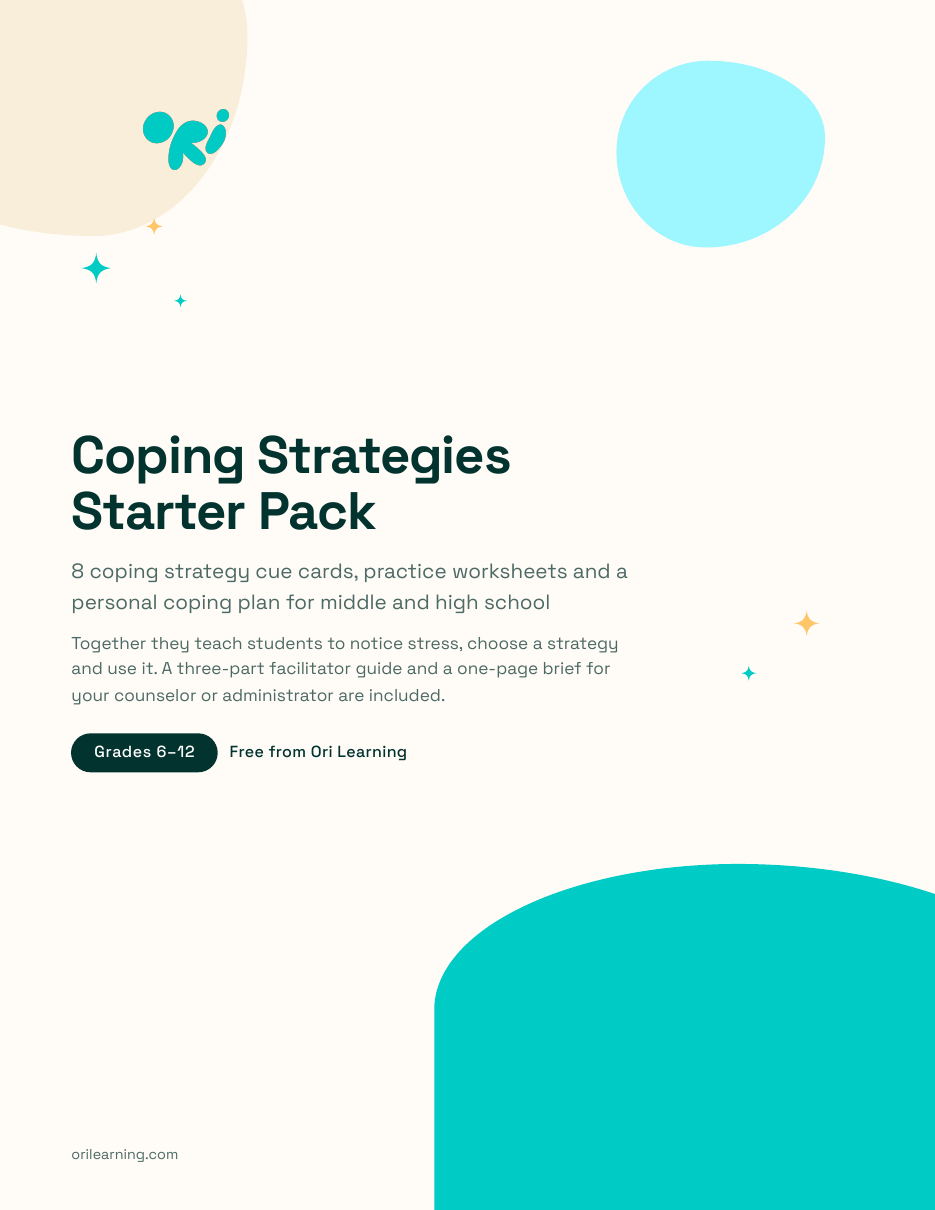
The free Coping Strategies Starter Pack includes this plan, plus cue cards for all eight strategies, a stress scale and practice log, and practice worksheets for grades 6–12.
How to tell if it’s working
You don’t need a formal assessment to see whether coping instruction is landing. Four light checks will tell you:
- Check-in use: notice whether students link their check-in to a strategy (“I’m at a 2, so I’ll do my breathing”), not whether the numbers go down.
- A short pre/post self-report: before you start and after a few weeks, students rate skill statements from 1 (not true for me) to 4 (very true for me), such as “When I’m stressed, I know at least two things I can try.” Keep it to skills, not how stressed students feel.
- A strategy-use exit ticket: “Which strategy did you use this week, and did it help? You don’t need to say what was going on.”
- An observation tally: count how often students use a strategy you can see, like the “I need a minute” signal or the reset space.
The red flag: a student who keeps telling you they’re stressed all the time, or who withdraws or seems different from usual, needs a conversation with the counselor, not more strategies. All four checks are informal reads on practice, not proof that stress went down. And if a student has self-regulation IEP goals, share what you’re seeing with the case manager so classroom strategies line up with the student’s plan.
When coping isn’t enough: when and how to refer
Coping strategies are for everyday stress. They aren’t treatment, and no one expects you to be a counselor. Your job is to notice and connect the student to help.
Warning signs that go beyond typical stress. Signs that a student needs more than a coping strategy include losing interest in things they used to enjoy, spending more and more time alone, using alcohol or drugs, self-harm and thoughts of suicide. If you notice these, talk to your school counselor. If a student mentions self-harm or suicide, follow your district’s protocols right away.
Crisis support. The 988 Suicide & Crisis Lifeline is free, confidential and available any time: call or text 988, or chat at 988lifeline.org. It’s on the coping plan above.
Coordinate with the counselor. Before you start, let your school counselor know you’re teaching these strategies, so they match any plan a student already has.
Trauma-informed classroom basics. A trauma-informed classroom isn’t a treatment setting. It’s a safe, predictable one. SAMHSA’s guidance on a trauma-informed approach names six principles, including safety; trustworthiness and transparency; collaboration and mutuality; and empowerment, voice and choice. In practice: keep routines predictable and warn students before changes, offer choices, build connection, and never require anyone to disclose what they’ve been through.
How the Emotional Well-Being Curriculum teaches coping
Ori Learning’s Emotional Well-Being Curriculum, an SEL curriculum for grades 6–12, teaches several of these strategies directly.
In the Grade 6 lesson “Handling Stress,” part of our middle school SEL curriculum, and the Grade 9 lesson of the same name in our high school SEL curriculum, students learn three strategies, which the Grade 6 lesson names Manage Your Symptoms, Prioritize Your Time and Manage Your Mindset. Then they read a peer’s situation and choose which strategy fits. Sixth graders read: “Tryouts for the school play are tomorrow!!! I’m so nervous… What if I forget my lines? What if I freeze up on stage?” Ninth graders read: “Why does getting into college have to be so hard? I have to complete FAFSA this week, finish two different college applications, and write as many scholarship essays as I can. This feels impossible.” Each lesson opens with a short warm-up and an emoji stress check-in (“Which emoji reflects your current stress level?”) and closes with an exit ticket.
In the Grade 7 lesson “Making Space” and the Grade 10 lesson “Acceptance,” students practice R.A.I.N. on a real, recent emotional experience in a “Let it Rain” activity. When you teach it, steer students to an everyday feeling and keep their work private. As the lessons put it: “Emotions aren’t good or bad. They are just signals to help us understand what we need in order to feel better.”
A recent third-party study following ESSA Level III standards included 1,829 students in grades 9–12 in a suburban New Jersey high school district. Students who completed all 25 lessons had 11% higher well-being scores than students who completed 5.
To see these lessons with your own classes, request a demo.
Coping strategies for students: quick answers
What are 5 coping strategies students can use at school?
Five coping skills students can practice in any classroom: (1) paced breathing, in for 4 and out for 6; (2) naming the feeling, first the body signal, then the word; (3) 5-4-3-2-1 grounding, from five things you see to one you taste; (4) breaking it down, listing tasks and picking one next step; and (5) asking for help with a ready-made line to a trusted adult.
How long does it take to teach a coping strategy?
About 10 minutes for most strategies the first time, and 15–20 for the ones done on paper: model it, practice it together, apply it to a scenario, then use it alone. After that, short practice a few times a week helps students reach for it on their own. Practice while students are calm, so the strategy is ready when stress hits.
How do I teach coping skills to high schoolers who think it’s corny?
Skip the cute framing and lead with performance: present breathing and reframing as routines for before a free throw, a solo or a big test. Model it honestly with your own stress, keep it short and give choices. Students pick which strategy to try and can practice silently. Asking them to rate whether it helped, instead of insisting it will, also cuts the eye-rolls.
Should middle and high school students use breaks or a calm-down space?
Yes, with a timer and a plan to come back. A short break to reset is healthy coping; a break with no plan to return can turn into avoidance. Start with 3–5 minutes, post the steps to use there, and agree on a return script: “I’m back, and I’m ready to…” If a student isn’t ready, check what they need.
Sources
- Centers for Disease Control and Prevention. (2026, September 21). CDC data show encouraging progress in youth health [2025 Youth Risk Behavior Survey results]. https://www.cdc.gov/media/releases/2026/cdc-data-show-encouraging-progress-in-youth-health.html
- Cipriano, C., et al. (2023). The state of evidence for social and emotional learning: A contemporary meta-analysis of universal school-based SEL interventions. Child Development, 94(5), 1181–1204. https://doi.org/10.1111/cdev.13968
- CASEL. What is the CASEL framework? https://casel.org/fundamentals-of-sel/what-is-the-casel-framework/
- Substance Abuse and Mental Health Services Administration. (2014). SAMHSA’s concept of trauma and guidance for a trauma-informed approach (HHS Publication No. SMA 14-4884). https://www.nctsn.org/sites/default/files/resources/resource-guide/samhsa_trauma.pdf
- 988 Suicide & Crisis Lifeline. https://988lifeline.org/
- National Institute of Mental Health. (2024). Children and mental health: Is this just a stage? https://www.nimh.nih.gov/health/publications/children-and-mental-health
- Yeager, D. S., et al. (2022). A synergistic mindsets intervention protects adolescents from stress. Nature, 607, 512–520. https://doi.org/10.1038/s41586-022-04907-7
- Brach, T. RAIN: Recognize, Allow, Investigate, Nurture. https://www.tarabrach.com/rain/; Brach, T. Two versions of acronym RAIN. https://www.tarabrach.com/blog-two-versions-of-acronym-rain/
Get the free Coping Strategies Starter Pack
A printable set for grades 6–12: cue cards for all eight strategies, practice worksheets, a stress log, a coping plan, a facilitator guide and a one-page brief for your team.
The download form isn’t loading right now. You can contact us with “Coping strategies pack” in your message and we’ll send you the same pack.
Your download link appears as soon as you submit. We’ll also email you the link. You can unsubscribe at any time.
