

You can’t observe self-esteem directly, but you can count what a student says about themselves out loud and what they do next. Good negative self-talk IEP goals target those two things: fewer statements like “I’m so stupid,” and a taught reframe, a short realistic phrase such as “This is hard, but I can fix one part,” that gets the student back to work.
What Negative Self-Talk Sounds Like at School, and When It Is More Than Self-Talk
Negative self-talk at school is any statement a student makes, out loud or in writing they share, that puts themselves down as a whole person or predicts their own failure. Common examples by age:
- Grades K–5: “I’m dumb,” “I can’t do anything,” ripping up a worksheet after a mistake.
- Grades 6–8: “Why even try,” “Everyone’s better than me,” refusing to read aloud.
- Grades 9–12 and 18–22 programs: “I’ll never pass,” “I’ll never get a job,” not turning work in.
It clusters after errors, before new or timed tasks, after corrective feedback, and when a student compares their work with a peer’s. Negative self-talk often travels with anxiety or depression, which the school psychologist or the student’s own clinician assesses; refer when statements are constant, worsening, or come with withdrawal or changes in sleep or appetite.
Eligibility category alone doesn’t decide whether a student gets one of these goals; the evaluation data do, since evaluations identify needs “whether or not commonly linked to the disability category” (34 CFR §300.304(c)(6)). Self-talk alone doesn’t establish emotional disturbance under §300.8(c)(4).
Safety first. If a student says or writes anything about self-harm or not wanting to live, that is not a data point for an IEP goal. Follow your school’s crisis or suicide-risk protocol right away and involve the school psychologist or counselor. That includes indirect statements such as “I wish I could fall asleep and never wake up again.” Stay with the student, don’t promise secrecy, and keep it off the data sheet; NASP advises school staff to act immediately and bring the student to a school-employed mental health professional or administrator (NASP). The same goes for job coaches off campus.
Self-Esteem Goals vs. Self-Talk Goals: Measure What You Can Hear and See
In a school setting, self-esteem IEP goals work best when they target what a student says and does: IDEA requires “measurable annual goals” (§300.320(a)(2)(i)), and no one on the IEP team can measure a feeling. A clinical treatment plan for self-esteem is a different document, written by the student’s own clinician.
“[Student] will improve self-esteem” fails because nothing in it can be counted. Three observable stand-ins replace it:
- Frequency of negative self-statements in a named period, counted by an adult.
- Use of a taught reframe after an error or feedback, out of the observed opportunities.
- Return to the task within a set number of minutes after an error.
The reframe doesn’t have to be cheerful: “I need help with step 2” counts, because it leads back to work. Self-concept scales given by qualified staff can inform present levels, but they aren’t the goal’s criterion. A five-decade meta-analysis of youth therapy trials found moderate average benefits, including for cognitive-behavioral approaches (Weisz et al., 2017), but that evidence comes from clinical treatment, not from any single IEP goal.
Baseline: A One-Week Count of Negative Self-Statements
A baseline is one week of event recording: a tally of negative self-statements in the two periods where they happen most, often math and writing. If a whole period is too much to track while teaching, count the same 20-minute independent-work segment daily and name it in the goal. Keep giving the usual classroom support during baseline week; the tally only records what happens.
| Counts | Doesn’t count |
|---|---|
| “I’m stupid.” / “I’m the worst at this.” | “This is hard.” |
| “Why even try? I’ll fail anyway.” | “I need help with number 4.” |
| Writing “I’m dumb” across a worksheet and showing it | “I got that one wrong.” (naming a real mistake) |
| “Everyone’s smarter than me.” | Quoting a negative thought during a lesson about negative thoughts |
Statements about death, self-harm or life never getting better aren’t counted; follow the safety steps. A run of statements before the student resumes work counts as one. Tally only what the student says or shows; don’t search private journals.
For each error or feedback moment, note any reframe, the minutes from feedback to the next on-task action, and what happened just before:
| Date | Period | Negative self-statements (tally) | Errors or feedback moments | Reframe used | Minutes to return to task | What happened just before |
|---|---|---|---|---|---|---|
| Tue 10/6 | Math | 7 | 5 | 1 of 5 | 4, 6, 2, 5, 3 | Corrected answer at board |
Add what your goals need: observer initials, minutes observed, prompt level, a weekly line for the counselor’s probe score. In the notes column, record triggers, not the student’s words. An optional 0–3 picture self-rating card gives the counselor the student’s view; it stays with the counselor’s records, off the shared sheet.
Negative Self-Talk and Self-Esteem IEP Goal Examples
Negative self-talk IEP goals name the setting, the trigger, the replacement and how often, for example: “After an error in math, [Student] will use a taught reframe and return to the task within 2 minutes in 4 of 5 opportunities across 3 consecutive weeks, as measured by teacher event recording.” Each goal below also has a baseline and a named collector. Start each with “By [annual review date],” and use your student’s own baseline. “4 of 5 opportunities across 3 consecutive weeks” means at least 80% in each week, with at least 5 opportunities that week; “say” includes whisper, write or point.
Every reduction is paired with a replacement, so the team can tell real coping from a student who has simply gone quiet. In goals triggered by the statements themselves (1, 2, 14, 15), carry a thin week’s opportunities into the next and report the falling count alongside. When [Student] says “I’m stupid,” prompt the taught reframe, fading from desk cue card to gesture to independent use, and keep the same phrase in math, writing and the counselor’s office. If the self-talk comes with a big emotional reaction, pair the goal with a self-regulation goal.
Noticing the Thought: Self-Monitoring Negative Self-Talk
1. Grades K–5. During independent math and reading centers, with a “stuck thought” picture card taped to the desk, [Student] will touch the card or say “stuck thought” before going back to the task after 4 of 5 observed negative self-statements across 3 consecutive weeks, as measured by event recording by the adult at that center (baseline: signaled after 0 of 9 observed statements across 3 days).
2. Grades 9–12 (counseling-service goal). During two daily academic periods, [Student] will record each negative self-statement [Student] says aloud on a self-monitoring card, with a count that matches the teacher’s independent count within ±1 in 8 of 10 periods per week (periods where the teacher counted 2 or more) across 3 consecutive weeks, as measured by a teacher–student agreement log (baseline: recorded 0 statements while the teacher counted 6–10 per period across 5 periods). The counselor teaches the card; the teacher checks transfer. The ±1 is a team rule, not a research standard.
3. Grades 9–12 (paired counseling probe). In weekly sessions with the school counselor, [Student] will rewrite 3 self-statements recorded that week (or practice statements the counselor supplies) into realistic alternatives (true, specific, pointing to a next step) with no more than 1 counselor prompt per rewrite in 3 of 4 sessions across 8 weeks, as measured by the counselor’s session probe sheet (baseline: rewrote 0 of 3 with prompting across the first 3 sessions).
Replacing the Statement With a Reframe
4. Grades 6–8. During math and writing periods, when [Student] makes an error or receives corrective feedback, [Student] will replace a negative self-statement (“I’m so stupid”) with a taught reframe from a desk cue card (“This is hard, but I can fix one part”) and return to the task within 2 minutes in 4 of 5 observed opportunities across 3 consecutive weeks, as measured by teacher event recording on the self-talk data sheet (baseline: averaged 8 negative self-statements per period; used a reframe in 0 of 6 observed error opportunities and returned to the task within 2 minutes in 2 of 6).
5. Grades K–5. After a math error in small-group instruction, given a picture card with a fix-it phrase (“Oops. I can try again.”), [Student] will say or point to the phrase and try the problem again within 1 minute, with no more than 1 gesture prompt, in 4 of 5 opportunities across 3 consecutive weeks, as measured by teacher event recording (baseline: 0 of 8 opportunities; said “I’m dumb” or pushed the work away in 6 of 8).
6. Grades 9–12. In English and science, after an error or corrective feedback the teacher observes, [Student] will say or write a taught reframe or ask for help, and return to the task within 2 minutes, in 4 of 5 observed opportunities (at least 6 per week) across 4 consecutive weeks, as measured by teacher event recording on the shared data sheet. The teacher also graphs statements in one 20-minute segment per class, aiming for 3 or fewer (baseline: median 9 per segment; reframe or help request after 0 of 12 error or feedback moments; back to work within 2 minutes after 3 of 12).
7. 18–22 programs. In vocational class, when [Student] makes a global statement about the future (“I’ll never get a job”), [Student] will restate it as a specific next step (“I’m still learning the register; I’ll practice two more times”) within 1 minute, with no more than 1 verbal prompt, in 4 of 5 opportunities across 4 consecutive weeks, as measured by the teacher’s event log (baseline: restated 0 of 6, even with prompting).
After a Mistake or Feedback: Staying With the Task
8. Grades K–5. When the teacher returns corrected work at the start of math, [Student] will keep the paper intact and fix one marked item within 3 minutes for 4 of 5 returned assignments across 3 consecutive weeks, as measured by teacher event recording (baseline: ripped or crumpled 4 of 6 returned papers; fixed 0 of 6).
9. Grades 6–8. Before each timed quiz or new independent task, [Student] will use a taught start-up statement (“Do the first one I know”) and begin within 1 minute in 4 of 5 opportunities across 3 consecutive weeks, as measured by a teacher latency log (baseline: began within 1 minute for 1 of 6 tasks, median 6 minutes; used the start-up statement 0 of 6).
10. 18–22 programs. At a work-based learning site, after a supervisor correction the job coach observes, [Student] will acknowledge it or ask a clarifying question and redo the step within 5 minutes without leaving the work area after 4 of 5 corrections across 4 consecutive weeks, as measured by the job coach’s event log (baseline: did both after 1 of 6 corrections; left the work area after 3 of 6).
Naming Strengths With Evidence
11. Grades K–5. In a weekly check-in with the school counselor, given a strengths picture card, [Student] will name 2 personal strengths and one thing [Student] did that week that shows each, without a prompt, in 3 of 4 check-ins across 6 consecutive weeks, as measured by the counselor’s check-in record (baseline: named 0–1 strengths and no evidence with prompting across 3 check-ins).
12. Grades 6–8. In a weekly counseling group, [Student] will write or dictate 2 entries in a “proof log,” each naming a strength and one piece of evidence from that week (a work sample, a teacher’s note), with no more than 1 prompt, in 3 of 4 sessions across 8 weeks, as measured by the counselor’s session probe sheet (baseline: 0 entries with evidence across 3 sessions).
13. Grades 9–12 and 18–22 programs. In 4 scheduled practice interviews in a career-readiness class, [Student] will name 3 strengths that fit the job or course, each with one example from school or work, with no more than 1 prompt, in 3 of 4 interviews across 6 weeks, as measured by the teacher’s interview rubric (baseline: named 1 strength with no example and needed 3 prompts in 2 practice interviews).
Naming strengths to the IEP team is the next step, in goals for explaining strengths and needs at the meeting.
Using a Coping Plan With the School Counselor
14. Grades 6–8. When [Student] marks a third negative self-statement in one period on a self-monitoring card taught in counseling, [Student] will flip the card to signal the teacher, use one coping-plan step (write the thought and a reframe on a sticky note, or take a 2-minute pass to a supervised spot) and return to the task within 5 minutes in 4 of 5 opportunities across 4 consecutive weeks, as measured by teacher event recording, with the counselor reviewing the card weekly (baseline: used a coping step in 0 of 5 opportunities; off task 10 minutes or more in 4 of 5).
15. Grades 9–12. As part of the same coping plan, when [Student] marks 3 or more statements about failing or quitting in one class, [Student] will use an in-class coping step or a pre-arranged pass to check in with the counselor, case manager or a named backup adult by the end of that period in 3 of 4 opportunities across 6 weeks, as measured by the counselor’s log matched against the card (baseline: 0 of 5; head down for the rest of the period in 4 of 5). What [Student] says in the check-in is not scored; a safety concern goes to the crisis protocol.
Related IEP Goal Resources
- writing SMART IEP goals
- self-regulation IEP goals
- social-emotional IEP goals
- school avoidance IEP goals
Writing Negative Self-Talk Goals as Counseling-Service Goals
When the team finds a student needs counseling to benefit from special education, the IEP lists it as a related service, and negative self-talk goals like these become the IEP counseling goals it supports. Counseling goals for an IEP still need the same five parts as any other goal. IDEA’s related services include counseling, psychological and school social work services (34 CFR §300.34); counseling is provided by “qualified social workers, psychologists, guidance counselors, or other qualified personnel,” as your state defines qualified.
The service line. The IEP states the service, its projected start date and its “anticipated frequency, location, and duration” (§300.320(a)(4) and (a)(7)); say whether sessions are individual or group. The team sets the minutes; this page suggests none. Put the baseline numbers in the present levels, and keep a session log that matches the service line so the two can be checked against each other.
Who measures what.
- The classroom teacher counts statements, reframe use and minutes to return to task.
- The counselor runs the session probe: rewriting statements, naming strengths, practicing the coping plan.
- Both use one data sheet, so the teacher sees whether the reframe practiced in the counselor’s office shows up in math. Districts differ on whether each related service needs its own goal; check your state’s form.
Reporting to families. The IEP must say how progress will be measured and when reports go home (§300.320(a)(3)). Report counts, reframe use, the trend and whether the student is on track, not what the student said in sessions. ASCA’s ethical standards hold that, as best practice, “a very limited number of educators would have access to highly sensitive information on a need-to-know basis” (ASCA, 2022, A.2.m). Write “used a reframe after 6 of 8 errors this month, up from 0 of 6; on track for the annual goal.”
Where rights transfer at the age of majority, they pass to the adult student (§300.520), so the student gets the report too.
Rewriting a Weak Negative Self-Talk Goal
Two rewrites, each turning a feeling into a count an adult can check:
Pair 1.
- Weak: “The student will improve self-esteem.”
- Why it fails: self-esteem isn’t observable, and there is no baseline, condition, count or time window.
- Strong: goal 13 (strengths with evidence) paired with goal 6 (reframe after errors, plus a statement count): one builds the self-esteem side, the other gives the team a number to watch in class.
Pair 2.
- Weak: “Each morning, the student will select a positive affirmation to focus on throughout the day, aiming to report feeling more positive on 4 out of 5 days per week.”
- Why it fails: the morning routine is fine, but the criterion is a feelings report no one else can check.
- Strong (Grades 6–8): “During morning advisory, [Student] will choose one coping statement from a menu of 5 and write it on a card kept with the math materials; after an error or corrective feedback in math, [Student] will say or point to that statement and return to work within 2 minutes in 4 of 5 observed opportunities across 3 consecutive weeks, as measured by teacher event recording (baseline across 3 days: used a planned statement after 0 of 7 errors; returned within 2 minutes after 2 of 7).”
Three mistakes undo these goals:
- Arguing with the statement (“You’re not stupid!”) instead of briefly acknowledging the frustration and prompting the taught reframe.
- Counting only reductions, which rewards silence rather than a new skill.
- Using a feelings self-report as the criterion.
Tracking Self-Talk Progress and Adjusting the Plan
Track negative self-talk IEP goals weekly on the baseline sheet and judge them every 3–4 weeks against decision rules set in advance. Two rows from one week:
| Date | Period | Negative self-statements (tally) | Errors or feedback moments | Reframe used | Minutes to return to task | What happened just before |
|---|---|---|---|---|---|---|
| Tue 10/6 | Math | 7 | 5 | 1 of 5 | 4, 6, 2, 5, 3 | Corrected answer at board |
| Thu 10/8 | Math | 5 | 4 | 2 of 4 | 2, 3, 5, 2 | Timed quiz |
| Week: 12 statements across 2 periods; reframe 3 of 9. | ||||||
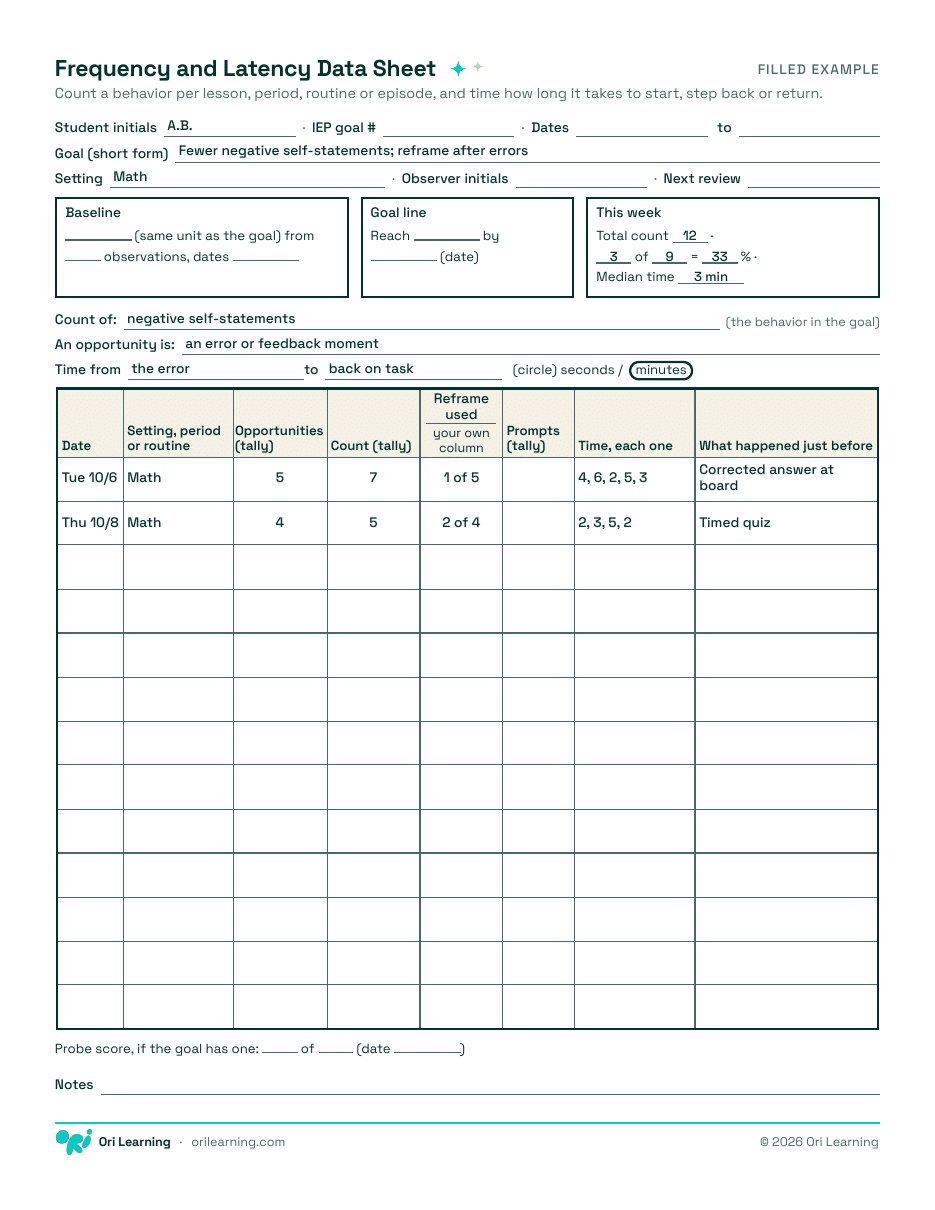
Print a blank copy (one page, no sign-up): Download the frequency and latency data sheet (PDF, one page)
Weekly, the teacher graphs statements and reframes and the counselor adds the probe score. Older students can graph their own counts. That is self-monitoring, which the IRIS Center describes as teaching students to “self-assess their behavior and record the results” (IRIS Center).
Every 3–4 weeks, look at level, trend and variability; in NCII guidance on behavior data, three to five data points is a rule of thumb before deciding on a change (NCII).
- Count flat across 5 weekly data points (usually by the second review): read the trigger notes and reteach the reframe in the setting where it isn’t working.
- Count down, no reframe heard: check return-to-task minutes. Quick returns may mean the reframe has gone silent, where self-talk instruction is meant to end up (IRIS Center); confirm with a quick “What did you tell yourself after that one?” Quiet and still off task means suppressing, not replacing; prompt the replacement statement.
- Any statement of self-harm: crisis protocol, outside the goal.
Reteaching happens within the goal; changing a criterion or the service takes an IEP meeting or written amendment (§300.324(a)(4) and (a)(6)). At mastery, check again 4 weeks later. Families get progress reports on the IEP’s schedule, plus the reframe phrase to use at home.
A Classroom Lesson on Reframing Negative Thoughts: “My Mindset”
“My Mindset” is Lesson 3 of the self-awareness unit in the Grade 8 course of Ori Learning’s Emotional Well-Being Curriculum. Students learn that mindset affects how they think, act and feel, and identify negative thoughts and their sources. Its reframing process starts with noticing: “The first step to changing a negative thought is to notice when one pops up!”
Students read five sample thoughts, such as a student doubting they’ll make the basketball team, and pick out the negative ones. For each, they look for the source: a past experience, their environment, or their brain trying to protect them (“Is your brain trying to keep you safe?”). Then they rewrite one, using the lesson’s model of changing “I can’t do this,” to “I can’t do this, yet.” A three-question journal closes the lesson.
The “notice it first” step matches goals 1–3. The lesson asks for a “more positive” version; for goal 3, the counselor can reuse the journal questions in session, with the student choosing the thought, and score whether the rewrite is realistic. A version for grades 11–12 is part of the Transition Curriculum.
Sources
- Individuals with Disabilities Education Act regulations: 34 CFR §300.34(a), (c)(2), https://sites.ed.gov/idea/regs/b/a/300.34; §300.320(a)(2)(i), (a)(3), (a)(4), (a)(7), https://sites.ed.gov/idea/regs/b/d/300.320; §300.8(c)(4), https://sites.ed.gov/idea/regs/b/a/300.8; §300.304(c)(6), https://sites.ed.gov/idea/regs/b/d/300.304; §300.324(a)(4), (a)(6), https://sites.ed.gov/idea/regs/b/d/300.324; §300.520(a), https://sites.ed.gov/idea/regs/b/e/300.520.
- IRIS Center, Vanderbilt University. SOS: Helping Students Become Independent Learners: Page 4, Self-Monitoring (https://iris.peabody.vanderbilt.edu/module/sr/cresource/q2/p04/), and Page 5, Self-Instruction (https://iris.peabody.vanderbilt.edu/module/sr/cresource/q2/p05/). Module: https://iris.peabody.vanderbilt.edu/module/sr/.
- National Association of School Psychologists. Preventing Youth Suicide: Tips for Parents and Educators. https://www.nasponline.org/resources-and-publications/resources-and-podcasts/school-safety-and-crisis/mental-health-resources/preventing-youth-suicide/preventing-youth-suicide-tips-for-parents-and-educators.
- American School Counselor Association. (2022). ASCA Ethical Standards for School Counselors, Standard A.2.m. https://www.schoolcounselor.org/getmedia/44f30280-ffe8-4b41-9ad8-f15909c3d164/EthicalStandards.pdf.
- National Center on Intensive Intervention. For students with intensive behavior needs, how many data points are needed to make decisions? https://intensiveintervention.org/resource/students-intensive-behavior-needs-how-many-data-points-are-needed-make-decisions.
- Weisz, J. R., Kuppens, S., Ng, M. Y., Eckshtain, D., Ugueto, A. M., Vaughn-Coaxum, R., Jensen-Doss, A., Hawley, K. M., Krumholz Marchette, L. S., Chu, B. C., Weersing, V. R., & Fordwood, S. R. (2017). What five decades of research tells us about the effects of youth psychological therapy: A multilevel meta-analysis and implications for science and practice. American Psychologist, 72(2), 79–117. https://doi.org/10.1037/a0040360.
